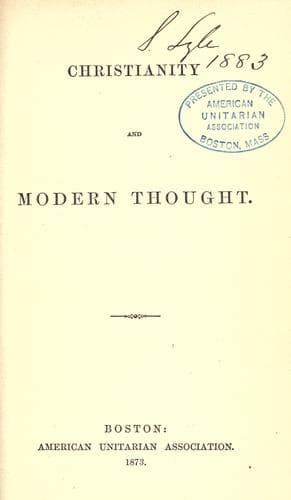
Christianity and Modern ThoughtPeabody, Andrew P. (Andrew Preston)
Religion
Christianity and Modern Thought
Peabody, Andrew P. (Andrew Preston)
Unitarianism
It has been assumed that the proof of divine revelation rests on
precisely those portions of the record which are most offensive to
unbelief. On this assumption the Christian apologists of a former
generation grounded their plea. Prove that we have the testimony of
eye-witnesses to the miracles recorded in the Gospels, and Christianity
is shown to be a divine revelation. In the absence of such proof (the
inference is) Christianity can no longer claim to be, in the words of
Paul, "the power of God unto salvation." This is substantially Paley's
argument. Planting himself on the premise that revelation is impossible
without miracles, in which it is implied that miracles prove revelation,
he labors to establish two propositions: 1. "That there is satisfactory
evidence that many professing to be original witnesses of the Christian
miracles passed their lives in dangers, labors, and sufferings,
voluntarily undergone in attestation of the accounts which they
delivered, and solely in consequence of their belief in those accounts;
and that they also submitted from the same motives to new rules of
conduct." 2. "That there is _not_ satisfactory evidence that persons
pretending to be original witnesses of any other similar miracles have
acted in the same manner in attestation of the accounts which they
delivered, and solely in consequence of their belief in the truth of
those accounts." The argument is stated with the characteristic
clearness of the author, and as well supported perhaps as Anglican
church-erudition in those days would allow; but the case is not made
out, and, if it were, the argument fails to satisfy the sceptical mind
of to-day. To say nothing of its gross misconception of the nature of
revelation, which it makes external instead of internal, a stunning of
the senses instead of mental illumination, an appeal to prodigy and not
its own sufficient witness,--waiving this objection, the argument fails
when confronted with the fact that, in spite of the evidence which
scholars and critics the most learned and acute of all time have arrayed
in support of the genuineness of the Gospels, the number is nowise
diminished, but rather increases, of intelligent minds that find
themselves unable, on the faith of any book, however ancient, to receive
as authentic a tale of wonders which contradict their experience of the
limits of human ability and their faith in the continuity of nature. For
myself, I beg to say, in passing, I am not of this number. I do not feel
the force of the objection against miracles drawn from this alleged
constancy of nature, which it seems to me reduces the course of human
events to a dead mechanical sequence, makes no allowance for any
reserved power in nature or any incalculable forces of the Spirit, and
virtually rules God, the present inworking God, out of the universe. I
can believe in any miracle which does not actually and demonstrably
contravene and nullify ascertained laws, however phenomenally foreign to
Public-domain text, read in full here on John Shaqi.
Reviews
Reviews
No reviews yet
Be the first to share your thoughts on this work.
Elsewhere in the archive
Join the Discussion
Join the discussion
Sign in to leave a comment or review.
Sign InorCreate an account