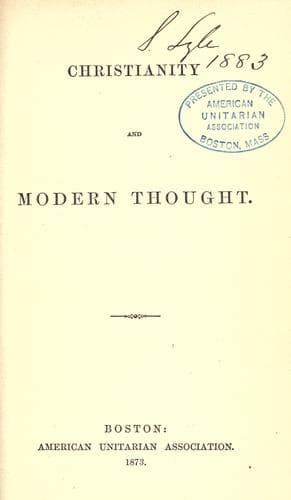
Christianity and Modern ThoughtPeabody, Andrew P. (Andrew Preston)
Religion
Christianity and Modern Thought
Peabody, Andrew P. (Andrew Preston)
Unitarianism
nature's ordinary course. But the possibility of miracles is one thing,
the possibility of proving them another. With such views as these
objectors entertain of the constancy of nature, I confess that no
testimony, not even the written affidavit of a dozen witnesses taken on
the spot, supposing that we had it, would suffice to convince me of the
truth of marvels occurring two thousand years ago, of the kind recounted
in the Gospels. My Christian prepossessions might incline me to believe
in them: the weight of evidence would not. No wise defender of the
Christian cause, at the present day, will rest his plea on the issue to
which Paley committed its claims. After all that Biblical critics and
antiquarian research have raked from the dust of antiquity in proof of
the genuineness and authenticity of the books of the New Testament,
credibility still labors with the fact that the age in which these books
were received and put in circulation was one in which the science of
criticism as developed by the moderns--the science which scrutinizes
statements, balances evidence for and against, and sifts the true from
the false--did not exist; an age when a boundless credulity disposed men
to believe in wonders as readily as in ordinary events, requiring no
stronger proof in the case of the former than sufficed to establish the
latter,--viz., hearsay and vulgar report; an age when literary honesty
was a virtue almost unknown, and when, consequently, literary forgeries
were as common as genuine productions, and transcribers of sacred books
did not scruple to alter the text in the interest of personal views and
doctrinal prepossessions. The newly discovered Sinaitic Code, the
earliest known manuscript of the New Testament, dates from the fourth
century. Tischendorf the discoverer, a very orthodox critic, speaks
without reserve of the license in the treatment of the text apparent in
this manuscript,--a license, he says, especially characteristic of the
first three centuries.
These considerations, though they do not discredit the essential facts
of the Gospel history,--facts assured to us, as I have said, by the
very existence of the Christian Church,--might seem to excuse the
hesitation of the sceptic in accepting, on the faith of the record,
incidental marvels of a kind very difficult of proof at best. I recall
in this connection the remarkable saying of an English divine of the
seventeenth century. "So great, in the early ages," says Bishop Fell,
"was the license of fiction, and so prone the facility of believing,
that the credibility of history has been gravely embarrassed thereby;
and not only the secular world, but the Church of God, has reason to
complain of its mythical periods."[9]
[Footnote 9: Tanta fuit primis seculis fingendi licentia, tam prona in
credendo facilitas, ut rerum gestarum fides graviter exinde laboraverit,
nec orbis tantum terrarum sed et Dei ecclesia de temporibus suis
mythicis merito queratur.]
Public-domain text, read in full here on John Shaqi.
Reviews
Reviews
No reviews yet
Be the first to share your thoughts on this work.
Elsewhere in the archive
Join the Discussion
Join the discussion
Sign in to leave a comment or review.
Sign InorCreate an account