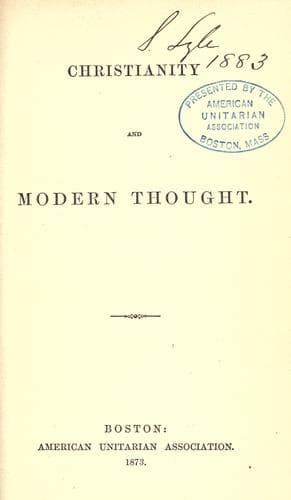
Christianity and Modern ThoughtPeabody, Andrew P. (Andrew Preston)
Religion
Christianity and Modern Thought
Peabody, Andrew P. (Andrew Preston)
Unitarianism
sketch or general plan of what I was projecting." The experiment which
required such careful preparation was to ascertain how far the English
public in the middle of the eighteenth century would bear to have it
said that the miracles affirmed by Augustine and Chrysostom and Jerome,
as occurring in their day, were not as worthy of credit as any of the
wonders recorded in the New Testament. Up to that time, English
Protestants as well as Romanists had given equal credence to both, and
esteemed the former as essential to Christian faith as the latter. Men
like Waterland and Dodwell and Archbishop Tillotson held that miracles
continued in the Church until the close of the third century, and were
even occasionally witnessed in the fourth. Whiston, the consistent
Arian, maintained their continuance up to the establishment of the
Athanasian doctrine in 381, and "that as soon as the Church became
Athanasian, antichristian, and popish, they ceased immediately; and the
Devil lent it his own cheating and fatal powers instead."
To me, I confess, the position of the Church of Rome in this matter
seems less indefensible than that of Middleton and modern Protestantism.
Either deny the possibility of miracles altogether to finite powers, or
admit their possibility in the second century, and the third century, as
well as the first, and in all centuries whenever a worthy occasion
demands such agency. I can see no reason for separating, as Middleton
does, the age of the Apostles from all succeeding. Had he drawn the line
between the miracles of Christ and those ascribed to his followers, the
principle of division would have been more intelligible, and more
admissible on the ground of ecclesiastical orthodoxy.
* * * * *
But the question here is not of the possibility or probability of
miracles, as such, in one age rather than another. It is a question
simply of Biblical interpretation,--whether the literal sense of the
record is in every case the true sense, whether history or fiction is
the key to certain Scriptures. Those who insist on the verbal
inspiration of the New Testament will be apt to likewise insist on the
literal historic sense of every part of every narrative. And yet that
mode of interpretation is by no means a necessary consequence or logical
outcome of that theory. Origen believed in the verbal inspiration of the
Old Testament, but Origen did not accept in their literal sense the
Hebrew theophanies: he allegorized whatever seemed to him to degrade the
idea of God. The Spirit can utter itself in fiction as well as fact, and
in communicating with Oriental minds was quite as likely to do so. And
surely, for those who reject the notion of verbal inspiration, the way
is open, in perfect consistency with Christian faith, for such
interpretation as reason may approve or the credit of the record be
thought to require. The credit of the record will sometimes require an
allegorical interpretation instead of a literal one.
Public-domain text, read in full here on John Shaqi.
Reviews
Reviews
No reviews yet
Be the first to share your thoughts on this work.
Elsewhere in the archive
Join the Discussion
Join the discussion
Sign in to leave a comment or review.
Sign InorCreate an account