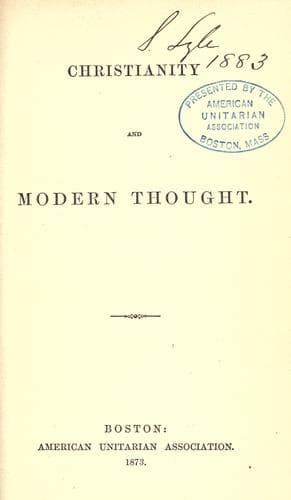
Christianity and Modern ThoughtPeabody, Andrew P. (Andrew Preston)
Religion
Christianity and Modern Thought
Peabody, Andrew P. (Andrew Preston)
Unitarianism
It is not in the interest of criticism, much less of a wilful
iconoclasm, from which my whole nature revolts, but of Christian faith,
that I advocate the supposition of a mythical element in the New
Testament. I am well aware that in this advocacy I shall lack the
consent of many good people who identify the cause of religion with its
accidents, and fancy that the sanctuary is in danger when a blind is
raised to let in new light. I respect the piety that clings to idols
which Truth has outgrown, as Paul at Athens respected the religion which
worshipped ignorantly the unknown God. But Truth once seen will draw
piety after it, and new sanctities will replace the old. No Protestant
in these days feels himself bound to accept as history the
ecclesiastical legends of the post-apostolic age. Some of them are quite
as significant as some of those embodied in the canon; but no Protestant
scruples to reject as spurious the story of the caldron of boiling oil
into which St. John was thrown by order of the Emperor Domitian, and
from which he escaped unharmed, or that of the lioness which licked the
feet of Thecla in the circus at Antioch, or Peter's encounter with
Christ in the suburbs of Rome. If we talk of evidence, I do not see but
the miracles said to be performed by the relics of martyrs at Milan,
attested by St. Augustine, and those of St. Cuthbert of Durham, attested
by the venerable Bede, are as well substantiated as the opening of the
prison doors and the liberation of the Apostles by an angel, attested by
Luke. The Church of Rome makes no such distinction between the first and
the following centuries: she indorses the miracles of all alike. But
modern Protestantism draws a line of sharp separation between the
apostolic and the post-apostolic ages. On the farther side the portents
are all genuine historic facts: on the hither side they are all
figments. While John the Evangelist, the last of the twelve, yet
breathed, a miracle was still possible: his breath departed, it became
an impossibility for evermore. And yet when Conyers Middleton first ran
this line between the ages, and published his refutation of the claim of
continued miraculous power in the Church, religious sensibility
experienced a shock as great as that inflicted in our day by Strauss,
and resented with equal indignation the affront to Christian faith. The
author of the "Free Inquiry" published in 1748 was assailed by
opponents, who "insinuate" he tells us "fears and jealousies of I know
not what consequences dangerous to Christianity, ruinous to the faith of
history, and introductive of universal scepticism." The larger work had
been preceded by an "Introductory Discourse" put forth as a feeler of
the public pulse; for "I began," he says, "to think it a duty which
candor and prudence prescribed, not to alarm the public at once with an
argument so strange and so little understood, nor to hazard an
experiment so big with consequences till I had at first given out some
Public-domain text, read in full here on John Shaqi.
Reviews
Reviews
No reviews yet
Be the first to share your thoughts on this work.
Elsewhere in the archive
Join the Discussion
Join the discussion
Sign in to leave a comment or review.
Sign InorCreate an account