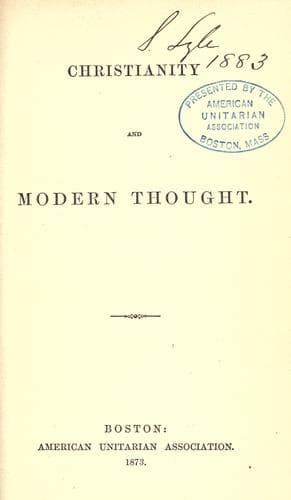
Christianity and Modern ThoughtPeabody, Andrew P. (Andrew Preston)
Religion
Christianity and Modern Thought
Peabody, Andrew P. (Andrew Preston)
Unitarianism
And so all that is memorable out of the past, all that tradition has
preserved, the veritable facts of history as well as the myths of
legendary lore, pass finally into ideas. Only as ideas they survive,
only as ideas have they any abiding value. The anecdote recorded of
Aristides--his writing his own name at the request of an ignorant
citizen on the shell that should condemn him--embodies a noble idea
which has floated down to us from the head-waters of Grecian history. Do
we care to know the evidence on which it rests? If by critical
investigation the fact were made doubtful, would that doubt at all
impair the truth of the idea? The story of Damon and Pythias, reported
by Valerius Maximus, for aught that we know, may be a myth: suppose it
could be proved to be so, the truth that is in it would be none the less
precious. We do not receive it on the faith of the historian, but on the
faith of its own intrinsic beauty. There is scarcely a fact in the
annals of mankind so vouched and ascertained as to be beyond the reach
of historic doubt, if any delver in ancient documents, or curious
sceptic, shall see fit to call it in question. But, however the fact may
be questioned, the idea remains. We have lived to see apologies for
Judas Iscariot, and the literary rehabilitation of Henry VIII. But Judas
is none the less, in popular tradition, the typical traitor, the
impersonation of devilish malice; and Henry VIII. is no less the
remorseless tyrant whose will was his God. When Napoleon I. pronounced
all history a fable agreed on, he reasoned better perhaps than he knew.
The agreement is the thing essential; but that agreement is never
complete, is never final. Every original writer of history finds
something to qualify, and often something to reverse, in the judgment of
his predecessors. How can it be otherwise, when even eye-witnesses
disagree in their observation and report of the same transaction; when
even in a matter so recent as the siege of Paris, or the conflagration
of Chicago, the verification of facts is embarrassed by contradictory
accounts? The best that history yields to philosophic thought is not
facts, but ideas. These are all that remain at last when the tale is
told,--all, at least, that the mind can appropriate, all that profits in
historical studies, the intellectual harvest of the past. A fact means
nothing until thought has transmuted it into itself: its value is simply
the idea it subtends. Homer's heroes are as true in this sense as those
of Plutarch. Ajax and Hector are as real to me as Cimon or Lysander; Don
Quixote's battle with the windmills which Cervantes imagined is as real
as the battle of Lepanto in which Cervantes fought; and Shakespeare's
Hamlet is incomparably more real than the Prince of Denmark whom Saxo
Grammaticus chronicles.
Public-domain text, read in full here on John Shaqi.
Reviews
Reviews
No reviews yet
Be the first to share your thoughts on this work.
Elsewhere in the archive
Join the Discussion
Join the discussion
Sign in to leave a comment or review.
Sign InorCreate an account