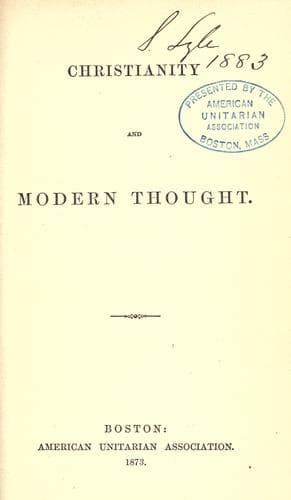
Christianity and Modern ThoughtPeabody, Andrew P. (Andrew Preston)
Religion
Christianity and Modern Thought
Peabody, Andrew P. (Andrew Preston)
Unitarianism
I do not underrate the importance of facts on their own historic plane.
The historian, as annalist, is bound by the rules of his craft with
conscientious investigation to ascertain, substantiate, and establish,
if he can, the precise facts of the period he explores. I only contend
that historic truth is not the only truth; that a fact,--if I may use
that term in this connection for want of a better,--that a fact which is
not historically true may yet be true on a higher plane than that of
history, true to reason, to moral and religious sentiment and human
need. The story of Christ's temptation is none the less true, but a
great deal more so, when the narrative which embodies the interior
psychological fact is conceived as myth, than when it is interpreted as
veritable history. The truth that concerns us is that the Son of Man
"was tempted in all points as we are," not that he was taken by the
Devil and set on a pinnacle of the Temple, and thence spirited away
"into an exceeding high mountain."
We have now attained a point of view from which to estimate on the one
hand the real import of what I have ventured to call the myths of the
New Testament, and on the other hand to overrule the petulant radicalism
which, not distinguishing truth of idea from truth of fact, contemns
these legends, and perhaps contemns the Gospel, on their account. I have
wished to show how unessential it is to the right enjoyment or
profitable use of those portions of the record that we receive them as
fact; to show that, if we seize and appropriate the idea, those
narratives are quite as edifying from a mythical as from an historical
point of view; in other words, that the Holy Spirit may and does
instruct by fiction as well as fact. If I am asked to draw the line
which separates fact from fiction, or to fix the criterion by which to
discriminate the one from the other, I answer that I do not pretend to
decide this point for myself, much less should I presume to attempt to
settle it for others. I am not disposed to dogmatize on the subject. It
is a matter in which each must judge for himself. I will only say that
for myself I do not place the line of demarcation between miracle and
the unmiraculous, for the reason that it seems to me, as I said before,
unphilosophical to make our every-day experience of the limits of human
power and the capabilities of nature an absolute standard by which to
measure the possible scope of the one or the other.
Public-domain text, read in full here on John Shaqi.
Reviews
Reviews
No reviews yet
Be the first to share your thoughts on this work.
Elsewhere in the archive
Join the Discussion
Join the discussion
Sign in to leave a comment or review.
Sign InorCreate an account