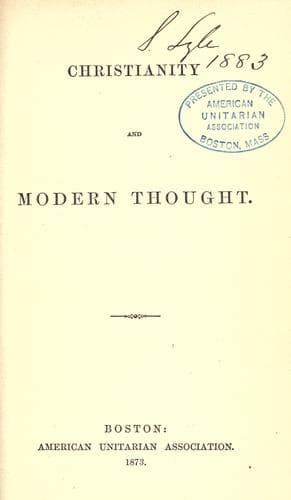
Christianity and Modern ThoughtPeabody, Andrew P. (Andrew Preston)
Religion
Christianity and Modern Thought
Peabody, Andrew P. (Andrew Preston)
Unitarianism
If the Christ of the Church, of Christian faith, is, as some will have
it, an ideal being, it was Jesus of Nazareth who made the ideal. The
ideal in him is simply the result of that disengagement from the earthly
vestiture which death and distance work in all who live in history. By
the very necessity of its function, history idealizes. The historic
figure and the individual represented by it, though inseparably one in
substance, are not so identical in outline that the one exactly covers
the other, no more and no less. The individual is the bodily presence as
it dwells in space; the historic figure is the image of himself which
the individual stamps on his time, and, so far as his record reaches, on
all succeeding time,--his import to human kind. That image is a
veritable portrait, but not in the sense of a _fac-simile_. A material
portrait, a portrait painted with hands, if the painter understands his
art, is not a _fac-simile_: it presents the chronic idea or
characteristic mode, not the temporary accidents, "the fallings off, the
vanishings," of the person portrayed. In the hero-galleries of
Tradition, as in the visions of the Apocalypse, they are seen with white
robes, and palms in their hands, and unwrinkled brows of grace, who in
life were begrimed with the dust and furrowed with the cares of their
time. St. Paul is there without his thorn in the flesh, Luther without
his impatience, Washington without his fiery choler, Lincoln without his
coarseness, Dante and Milton without their scorn. History strips off the
indignities of earth when she dresses her heroes for immortality. And
the transfigurations she gives us are nearer the truth than the
limitations of ordinary life. The man is more truly himself in the epic
strain of public action, with spirit braced and harness on, than in the
subsidence and undress of the closet. It is not the gossiping anecdotes,
the spoils of the ungirt private life, so dear to antiquaries and
literary scavengers, but the things which history hastens to record,
that show the man. We must take the life at full-tide; we must view it
in its freest determination, in its supreme moment, to know the deepest
that is in him. And the deepest that is in him is the true man. That is
his idea, his mission to the world, his historic significance. It is
this that concerns us in all the great actors of history,--the historic
person, not the individual. And the more the historic person absorbs the
individual, the higher we rise in the scale of being until we reach the
idea of God, from which all individuality is excluded, and only the
Person remains, filling space and time with the ceaseless procession of
his being.
We misread the Gospel and reverse the true and divine order, if we
suppose the ideal Christ to be an essence distilled from the historical.
On the contrary, the ideal Christ is the root and ground of the
historical; and without the antecedent idea inspiring, commanding, the
history would never have been.
Public-domain text, read in full here on John Shaqi.
Reviews
Reviews
No reviews yet
Be the first to share your thoughts on this work.
Elsewhere in the archive
Join the Discussion
Join the discussion
Sign in to leave a comment or review.
Sign InorCreate an account