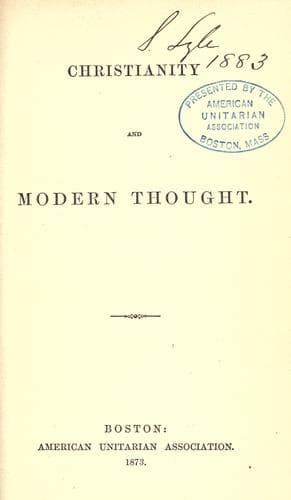
Christianity and Modern ThoughtPeabody, Andrew P. (Andrew Preston)
Religion
Christianity and Modern Thought
Peabody, Andrew P. (Andrew Preston)
Unitarianism
I content myself with a single illustration of what I regard as a
mythical formation. My example is the story known as "The Annunciation."
Luke alone, of all the evangelists, records the tale. The angel Gabriel
is sent to a virgin named Mary, and surprises her with the tidings,
"Thou shalt conceive in thy womb, and shalt bring forth a son, and shalt
call his name Jesus. He shall be great, and shall be called the Son of
the Highest. And the Lord God shall give unto him the throne of his
father David. And he shall reign over the house of Jacob for ever, and
of his kingdom there shall be no end." This beautiful legend, the most
beautiful, I think, of all the legends connected with the birth of
Christ, the favorite theme of Christian art, so lovingly handled by Fra
Angelico, by Correggio, Raphael, Titian, Andrea del Sarto, and a host of
others, is best understood as a Jewish-Christian conception, taking an
historic form and "shaped into a fact." The legend represents the
humility and faith of a pious maiden communing with the heavenly
Presence, drawing to herself divine revelations of grace and promise,
and thus sanctioning the hope so dear to every Jewish maiden,--that of
becoming the mother of the Messiah. The sudden inspiration of that hope
is the angel of the Annunciation.
A word more. How far is our idea of Christ affected by a mode of
interpretation which supposes a mingling of mythical with historic
elements in the Gospel record? That idea is based on the representations
of the evangelists. Will not our confidence in those representations be
impaired by this view of their contents? I see no cause to apprehend a
result so distressing to Christian faith. The mythical interpretation of
certain portions of the Gospel has no appreciable bearing on the
character of Christ. The impartial reader of the record must see that
the evangelists did not invent that character; they did not make the
Jesus of their story; on the contrary, it was he that made them. It is a
true saying that only a Christ could invent a Christ. The Christ of
history is a true reflection of the image which Jesus of Nazareth
imprinted on the mind of his contemporaries. In that image the spiritual
greatness, the moral perfection, are not more conspicuous than the
well-defined individuality which permeates the story, and which no
genius could invent.
Public-domain text, read in full here on John Shaqi.
Reviews
Reviews
No reviews yet
Be the first to share your thoughts on this work.
Elsewhere in the archive
Join the Discussion
Join the discussion
Sign in to leave a comment or review.
Sign InorCreate an account