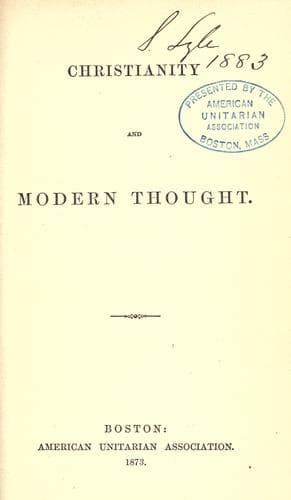
Christianity and Modern ThoughtPeabody, Andrew P. (Andrew Preston)
Religion
Christianity and Modern Thought
Peabody, Andrew P. (Andrew Preston)
Unitarianism
In dealing with these three conceptions,--of _Creation_, _Construction_,
_Evolution_,--there is one thing on which Religion insists, viz., that
_Mind is first, and rules for ever_; and, whatever the process be, is
_its_ process, moving towards congenial ends. Let this be granted, and
it matters not by what path of method the Divine Thought advances, or
how long it is upon the road. Whether it flashes into realization, like
lightning out of Night; or fabricates, like a Demiurge, through a
producing season, and then beholds the perfect work; or is for ever
thinking into life the thoughts of beauty and the love of good; whether
it calls its materials out of nothing, or finds them ready, and disposes
of them from without; or throws them around as its own manifestation,
and from within shapes its own purpose into blossom,--makes no
difference that can be fatal to human piety. Time counts for nothing
with the Eternal; and though it should appear that the system of the
world and the ranks of being arose, not by a start of crystallization,
but, like the grass or the forest, by silent and seasonal gradations, as
true a worship may be paid to the Indwelling God who makes matter itself
transparent with spiritual meanings, and breathes before us in the
pulses of nature, and appeals to us in the sorrows of men, as to the
pre-existing Deity who, from an infinite loneliness, suddenly became the
Maker of all. Nay, if the poet always looks upon the world through a
suppliant eye, craving to meet his own ideal and commune with it alive;
if prayer is ever a "feeling after Him to find Him," the fervor and the
joy of both must be best sustained, if they are conscious not only of
the stillness of His presence, but of the movement of His thought, and
never quit the date of His creative moments. In the idea, therefore, of
a gradual unfolding of the creative plan, and the maturing of it by
rules of growth, there is nothing necessarily prejudicial to piety; and
so long as the Divine Mind is left in undisturbed supremacy, as the
living All in all, the belief may even foster a larger, calmer, tenderer
devotion, than the conceptions which it supersedes. But it is liable to
a special illusion, which the others by their coarsely separating lines
manage to escape. Taking all the causation of the world into the
interior, instead of setting it to operate from without, it seems to
dispense with God, and to lodge the power of indefinite development in
the first seeds of things; and the apprehension seizes us, that as the
oak will raise itself when the acorn and the elements are given, so from
its germs might the universe emerge, though nothing Divine were there.
The seeds no doubt were on the field; but who can say whether ever "a
Sower went forth to sow"? So long as you plant the Supreme Cause at a
distance from His own effects, and assign to Him a space or a time where
nothing else can be, the conception of that separate and solitary
existence, however barren, is secure.
Public-domain text, read in full here on John Shaqi.
Reviews
Reviews
No reviews yet
Be the first to share your thoughts on this work.
Elsewhere in the archive
Join the Discussion
Join the discussion
Sign in to leave a comment or review.
Sign InorCreate an account