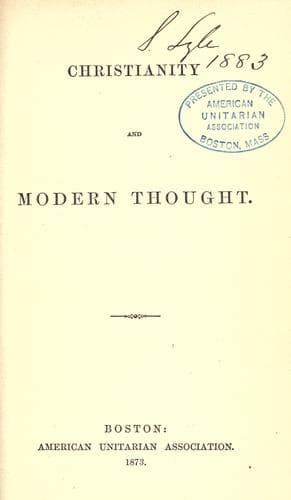
Christianity and Modern ThoughtPeabody, Andrew P. (Andrew Preston)
Religion
Christianity and Modern Thought
Peabody, Andrew P. (Andrew Preston)
Unitarianism
But in proportion as you think of
Him as never in an empty field, waiting for a future beginning of
activity, as you let Him mingle with the elements and blend with the
natural life of things, there is a seeming danger lest His light should
disappear behind the opaque material veil, and His Spirit be quenched
amid the shadows of inexorable Law. This danger haunts our time. The
doctrine of Evolution, setting itself to show how the greatest things
may be brought out of the least, fills us with fear whether perhaps Mind
may not be last instead of first, the hatched and full-fledged form of
the protoplasmic egg; whether at the outset any thing was there but the
raw rudiments of matter and force; whether the hierarchy of organized
beings is not due to progressive differentiation of structure, and
resolvable into splitting and agglutination of cells; whether the
Intellect of man is more than blind instinct grown self-conscious, and
shaping its beliefs by defining its own shadows; whether the Moral sense
is not simply a trained acceptance of rules worked out by human
interests, an inherited record of the utilities; so that Design in
Nature, Security in the Intuitions of Reason, Divine Obligation in the
law of Conscience, may all be an illusory semblance, a glory from the
later and ideal days thrown back upon the beginning, as a golden sunset
flings its light across the sky, and, as it sinks, dresses up the East
again with borrowed splendor.
This doubt, which besets the whole intellectual religion of our time,
assumes that we must _measure every nature in its beginnings_; admit
nothing to belong to its essence except what is found in it then; and
deny its reports of itself; so far as they depart from that original
standard. It takes two forms, according as the doctrine of Evolution is
applied to Man himself, or to the outward universe. In the former case,
it infuses distrust into our self-knowledge, weakens our subjective
religion or native faith in the intuitions of thought and conscience,
and tempts us to imagine that the higher they are, the further are they
from any assured solidity of base. In the latter case, it weakens our
objective religion, suggests that there is no originating Mind, and that
the divine look of the world is but the latest phase of its finished
surface, instead of the incandescence of its inmost heart. Let us first
glance at the theory of HUMAN evolution, and the moral illusions it is
apt to foster.
Public-domain text, read in full here on John Shaqi.
Reviews
Reviews
No reviews yet
Be the first to share your thoughts on this work.
Elsewhere in the archive
Join the Discussion
Join the discussion
Sign in to leave a comment or review.
Sign InorCreate an account