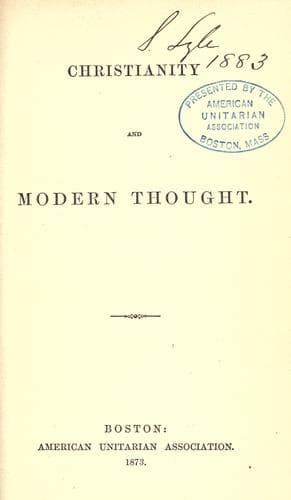
Christianity and Modern ThoughtPeabody, Andrew P. (Andrew Preston)
Religion
Christianity and Modern Thought
Peabody, Andrew P. (Andrew Preston)
Unitarianism
(2) Further, the question to be determined may be presented as a problem
in physiology, to be resolved by corresponding rules: What is the
_function_ of certain parts of our human constitution, viz., the Reason
and the Moral Faculty? Now it is a recognized principle that, in
estimating function, you must study the organ, not in its rudimentary
condition, before it has disengaged itself from adjacent admixtures and
flung off the foreign elements, but in its perfect or differentiated
state, so as to do its own work and nothing else. In order to give the
idea of a timepiece to one who had it not, you would not send him to one
of the curious mediæval clocks which could play a tune, and fire a gun,
and announce the sunrise, and mark the tides, and report twenty
miscellaneous things besides; but to the modern chronometer, simple and
complete, that, telling only the moment, tells it perfectly. And in
natural organizations, to learn the capabilities and project of any
structure, you would not resort to the embryo where it is forming but
not working: you would wait till it was born into the full presence of
the elements with which it had to deal; not till then could you see how
they played upon it, and what was its response to them. In conformity
with this rule, whither would you betake yourself, if you want to
measure the intrinsic competency of our intellectual faculty, and
determine what its very nature gives it to know? Would you take counsel
of the nurse who held you "when you first opened your eyes to the
light,"[10] or otherwise study "the first consciousness in any infant,"
"before the time when memory commences,"[11] and disregard every thing
"subsequent to the first beginnings of intellectual life"?[12] On the
contrary, you would avoid that soft inchoate promise of nature, only
nominally born, where the very structures of its finer work have not yet
set into their distinctive consistency and form; and will hold your
peace till the faculty is awake and on its feet, and can clearly tell
you what it sees for itself, and what it makes out at second-hand: just
as, to gauge the lunar light, you must have patience while the thin
crescent grows, and wait till the full orb is there. Still less can you
take the report of the Moral Faculty from the confessions of the cradle,
or from the quarrels and affections of the apes; the conditions being
not yet present for the bare conception of a moral problem. The most
that can be asked of an intuition is, that it shall keep pace with the
cases as they arise, and be on the spot when it is wanted; and if you
would know what provision our nature holds for dealing with its Duty and
interpreting its guilt, you must go into the thick of its moral life,
and bid it tell you what it sees from the swaying tides of temptation
and of victory. The "purity" of intuitions is not "pristine," but
ultimate; cleared at length from accidental and irrelevant dilutions,
Public-domain text, read in full here on John Shaqi.
Reviews
Reviews
No reviews yet
Be the first to share your thoughts on this work.
Elsewhere in the archive
Join the Discussion
Join the discussion
Sign in to leave a comment or review.
Sign InorCreate an account