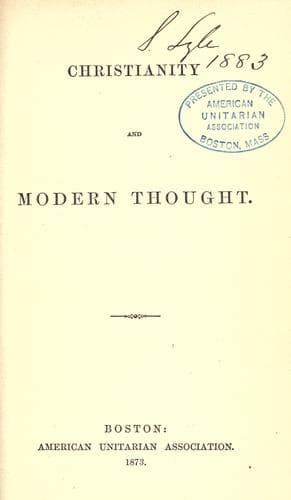
Christianity and Modern ThoughtPeabody, Andrew P. (Andrew Preston)
Religion
Christianity and Modern Thought
Peabody, Andrew P. (Andrew Preston)
Unitarianism
(1) Though animal sensation, with its connected instinct, should be the
raw material of our whole mental history, it is not on that account
entitled _to measure all that comes after it_, and stand as the
boundary-line between fact and dream, between terra firma and "airy
nothing." That which is first in Time has no necessary priority of rank
in the scale of truth and reality; and the later-found may well be the
greater existence and the more assured. If it is a development of
Faculty, and not of incapacity, which the theory provides, the process
must advance us into new light, and not withdraw us from clearer light
behind: and we have reason to confide in the freshest gleams and inmost
visions of to-day, and to discard whatever quenches and confuses them in
the vague and turbid beginnings of the Past. With what plea will you
exhort me, "If you would rid yourself of intellectual mysteries, come
with us, and see the stuff your thought is made of: if you would stand
free of ideal illusions, count with us the medullary waves that have run
together into the flood-tide of what you call your conscience: if you
would shake off superstition, look at the way in which the image of dead
men will hang about the fancy of a savage, or the personification of an
abstract quality imposes on the ignorance of simple times"? Is our
wisdom to be gathered by going back to the age before our errors? And
instead of consulting the maturity of thought, are we to peer into its
cradle and seek oracles in its infant cries? If the last appeal be to
the animal elements of experience, we can learn only by unlearning; and
by shutting one after another of the hundred ideal eyes of the finished
intellect, we shall have a chance of seeing and feeling things as they
are. If nothing is to be deemed true but what the pre-human apes saw,
then all the sciences must be illusory; with the suicidal result that,
with them, this doctrine of Evolution must vanish too. Or if, stopping
short of this extreme distrust of the acquired intuitions, you make a
reservation in favor of the new visions of the intellect, what right can
you show for discharging those of the conscience? The tacit assumption
therefore that you upset a super-sensual belief, by tracing the history
of its emergence among sensible conditions, is a groundless prejudice.
Public-domain text, read in full here on John Shaqi.
Reviews
Reviews
No reviews yet
Be the first to share your thoughts on this work.
Elsewhere in the archive
Join the Discussion
Join the discussion
Sign in to leave a comment or review.
Sign InorCreate an account