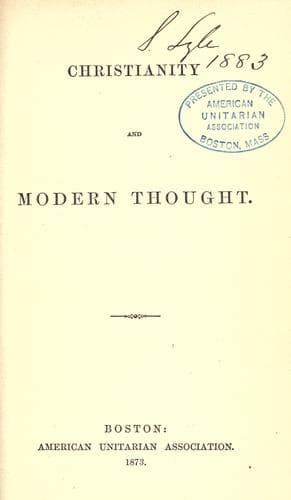
Christianity and Modern ThoughtPeabody, Andrew P. (Andrew Preston)
Religion
Christianity and Modern Thought
Peabody, Andrew P. (Andrew Preston)
Unitarianism
(1) The genius of a country which has been the birthplace and chief home
of Political Economy is naturally pleased by a theory of this kind;
which invests its favorite lord and master, _Competition_, with an
imperial crown and universal sway. But let us not deceive ourselves with
mere abstract words and abbreviations, as if they could reform a world
or even farm a sheep-walk. _Competition_ is not, like a primitive
function of nature, an independent and original power, which can of
itself do any thing: the term only describes a certain intensifying of
power already there; making the difference, under particular conditions,
between function latent and function exercised. It may therefore turn
the less into the more; and it is reasonable to attribute to it an
_increment_ to known and secured effects; but not new and unknown
effects, for which else there is no provision. It gives but a partial
and superficial account of the phenomena with which it has concern; of
their degree; of their incidence here or there; of their occurrence now
or then: of themselves in their characteristics it pre-supposes, and
does not supply, the cause. To that cause, then, let us turn. Let us
consider what must be upon the field, before competition can arise.
(2) It cannot act except in the presence of some _possibility of a
better or worse_. A struggle out of relative disadvantage implies that a
relative advantage is within grasp,--that there is a prize of promotion
offered for the contest. The rivalry of beings eager for it is but an
instrument for _making the best of things_; and only when flung into the
midst of an indeterminate variety of alternative conditions can it find
any scope. When it gets there and falls to work, what does it help us to
account for? It accounts certainly for the triumph and _survivorship of
the better_, but not for there _being a better to survive_. _Given_, the
slow and the swift upon the same course, it makes it clear that the race
will be to the swift; but it does not provide the fleeter feet by which
the standard of speed is raised. Nay more; even for the prevalence of
the better ("or fitter to live") it would not account, except on the
assumption that whatever is _better_ is _stronger_ too; and a universe
in which this rule holds already indicates its divine constitution, and
is pervaded by an ideal power unapproached by the forces of necessity.
Thus the law of "natural selection," instead of dispensing with anterior
causation and enabling the animal races to be their own Providence and
do all their own work, distinctly testifies to a constitution of the
world pre-arranged for progress, externally spread with large choice of
conditions, and with internal provisions for seizing and realizing the
best. On such a world, rich in open possibilities, of beauty, strength,
affection, intellect, and character, they are planted and set free;
charged with instincts eagerly urging them to secure the preferable line
Public-domain text, read in full here on John Shaqi.
Reviews
Reviews
No reviews yet
Be the first to share your thoughts on this work.
Elsewhere in the archive
Join the Discussion
Join the discussion
Sign in to leave a comment or review.
Sign InorCreate an account