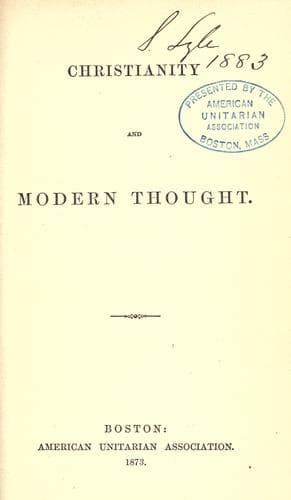
Christianity and Modern ThoughtPeabody, Andrew P. (Andrew Preston)
Religion
Christianity and Modern Thought
Peabody, Andrew P. (Andrew Preston)
Unitarianism
of each alternative; and disposing themselves, by the very conditions of
equilibrium, into a natural hierarchy, in which the worthiest to live
are in the ascendant, and the standard of life is for ever rising. What
can look more like the field of a directing Will intent upon the good?
Indeed, the doctrine of "natural selection" owes a large part of its
verisimilitude to its skilful imitation of the conditions and method of
Free-will;--the indeterminate varieties of possible movement; the
presentation of these before a selective power; the determination of the
problem by fitness for preference,--all these are features that would
belong no less to the administration of a presiding Mind; and that,
instead of resorting for the last solution to this high arbitrament, men
of science should suppose it to be blindly fought out by the competing
creatures, as if they were supreme, is one of the marvels which the
professional intellect, whatever its department, more often exhibits
than explains.
(3) But, before competition can arise, there must be, besides the field
of favorable possibility, _desire or instinct_ to lay hold of its
opportunities. Here it is that we touch the real dynamics of evolution,
which rivalry can only bring to a somewhat higher pitch. Here, it must
be admitted, there is at work a genuine principle of progression, the
limits of which it is difficult to fix. Every being which is so far
individuated as to be a separate centre of sensation, and of the
balancing active spontaneity, is endowed with a self-asserting power,
capable, on the field already supposed, of becoming a self-advancing
power. Under its operation, there is no doubt, increasing
differentiation of structure and refinement of function may be expected
to emerge; nor is there any reason, except such as the facts of natural
history may impose, why this process should be arrested at the
boundaries of the species recognized in our present classifications.
Possibly, if the slow increments of complexity in the organs of sentient
beings on the globe were all mapped out before us, the whole teeming
multitudes now peopling the land, the waters, and the air, might be seen
radiating from a common centre in lines of various divergency, and,
however remote their existing relations, might group themselves as one
family. The speculative critic must here grant without stint all that
the scheme of development can ask; and he must leave it to the
naturalist and physiologist to break up the picture into sections, if
they must. But then, _Why_ must he grant it? Because here, having
crossed the margin of animal life, we have, in its germ of feeling and
idea, not merely a persistent, but a self-promoting force, able to turn
to account whatever is below it; the mental power, even in its
rudiments, dominating the vital, and constraining it to weave a finer
organism; and, for that end, to amend its application of the chemical
forces, and make them better economize their command of mechanical
Public-domain text, read in full here on John Shaqi.
Reviews
Reviews
No reviews yet
Be the first to share your thoughts on this work.
Elsewhere in the archive
Join the Discussion
Join the discussion
Sign in to leave a comment or review.
Sign InorCreate an account