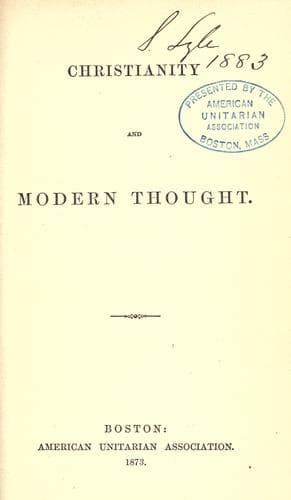
Christianity and Modern ThoughtPeabody, Andrew P. (Andrew Preston)
Religion
Christianity and Modern Thought
Peabody, Andrew P. (Andrew Preston)
Unitarianism
force. Observe, however, that, if here we meet with a truly fruitful
agency, capable of accomplishing difficult feats of new combination and
delicate equilibrium, we meet with it _here first_; and the moment we
fall back from the line of sentient life, and quit the scene of this
eager, aggressive, and competing power, we part company with all
principle of progress; and consequently lose the tendency to that
increasing complexity of structure and subtlety of combination which
distinguish the organic from the inorganic compounds. Below the level of
life, there is no room for the operation of "natural selection." Its
place is there occupied by another principle, for which no such wonders
of constructive adaptation can be claimed;--I mean, the dynamic rule of
_Action on the line of least resistance_,--a rule, the working of which
is quite in the opposite direction. For evidently it goes against the
establishment of unstable conditions of equilibrium, and must therefore
be the enemy rather than the patron of the complex ingredients, the
precarious tissues, and the multiplied relations, of sentient bodies;
and on its own theatre must prevent the permanent formation of any but
the simpler unions among the material elements. Accordingly, all the
great enduring masses that form and fill the architecture of inorganic
nature,--its limestone and clay, its oxides and salts, its water and
air,--are compounds, or a mixture, of few and direct constituents. And
the moment that life retreats and surrenders the organism it has built
and held, the same antagonist principle enters on possession, and sets
to work to destroy the intricate structure of "proximate principles"
with their "compound radicals." With life and mind therefore there
begins, whether by modified affinities or by removal of waste, a
_tension_ against these lower powers, carrying the being up to a greater
or less height upon the wing; but with life it ends, leaving him then to
the perpetual gravitation that completes the loftiest flight upon the
ground. Within the limits of her Physics and Chemistry alone, Nature
discloses no principle of progression, but only provisions for
periodicity; and out of this realm, without further resources, she could
never rise.
Public-domain text, read in full here on John Shaqi.
Reviews
Reviews
No reviews yet
Be the first to share your thoughts on this work.
Elsewhere in the archive
Join the Discussion
Join the discussion
Sign in to leave a comment or review.
Sign InorCreate an account