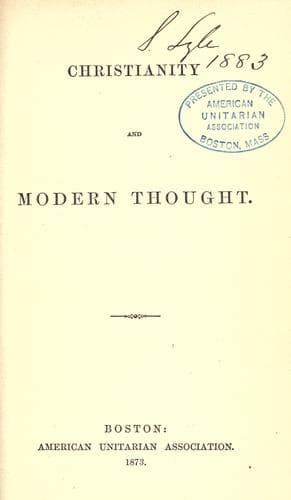
Christianity and Modern ThoughtPeabody, Andrew P. (Andrew Preston)
Religion
Christianity and Modern Thought
Peabody, Andrew P. (Andrew Preston)
Unitarianism
abolish a living God from the heart and faith of man, to disprove the
essential truths of Christianity, or to make life and the human soul
less sacred, aspiring, and religious, the world would be on its rapid
way to atheism. But I maintain that science itself, philosophy and free
inquiry, however divorced from religious institutions and dogmas, were
never so humble, reverential, and Christian as since they partly
emancipated themselves from theological or ecclesiastical censure and
suspicion. For ages science knelt to religion as she went to her
crucible or laboratory, like the sexton passing the altar in a Catholic
cathedral, and with as little thought or feeling as he, simply to avert
censure, while she pursued inquiries she knew would banish the
superstition she pretended to honor. Faith and knowledge were at
opposite poles; religious truth and scientific truth, finally and
permanently amenable to different standards. How dishonoring to religion
was this distrust of light and knowledge! how faithless in God, this
faith in him which could not bear investigation! how compromising to
Christianity, the sort of trust which refuses as blasphemous the
application of all the tests and proofs which are required in the
certification of every other important conviction! Religious faith rests
on the spiritual nature; but its basis is not less real for being
undemonstrable, like the axioms of mathematics. That is not real faith
which dares not investigate the grounds of its own being. It is
irreverent to God, to affirm that he does not allow us to try his ways;
to demand proofs of his existence and righteous government; to ask for
the credentials of his alleged messengers; to doubt until we are
rationally convinced. If the artificial feeling that faith is opposed to
reason; religious truth to universal truth; that belief in unseen things
is less rational or less capable of verification than the radical
beliefs of the senses,--if these prejudices were sound, or not the
reverse of true, the world would be on its inevitable way to universal
infidelity and godless materialism. But is that the tendency of things?
Is it that religion is growing _less_ mystic? or only science more so?
Have not real and affecting mysteries been very much transferred for the
time from theology to philosophy, from the priest to the professor? I
doubt very much whether men of science are not more truly on their knees
than men of superstition, in our days. Never did such candor, such
confessions of baffled insight, such a sense of inscrutable wisdom and
power, such a feeling of awe and dependence, seem to prevail in science
as now, when so many theologians are raising the eyebrow, and seeking to
alarm the world at what they call the atheism of the most truth-loving,
earnest, and noble men. I would sooner have the scepticism--reverent and
honest and fearless--of these solemn and awed inquisitors in the inner
shrines of nature, than the faith of self-bandaged priests, who are
Public-domain text, read in full here on John Shaqi.
Reviews
Reviews
No reviews yet
Be the first to share your thoughts on this work.
Join the Discussion
Join the discussion
Sign in to leave a comment or review.
Sign InorCreate an account