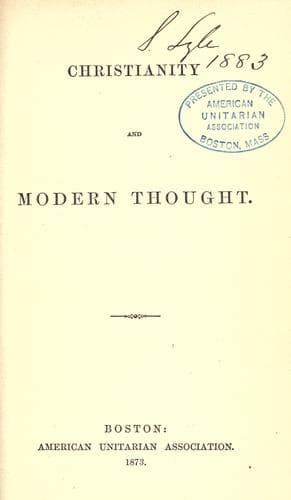
Christianity and Modern ThoughtPeabody, Andrew P. (Andrew Preston)
Religion
Christianity and Modern Thought
Peabody, Andrew P. (Andrew Preston)
Unitarianism
If the Divine Idea will not retire at the bidding of our speculative
science, but retains its place, it is natural to ask, what is its
relation to the series of so-called Forces in the world? But the
question is too large and deep to be answered here. Let it suffice to
say, that there need not be any _overruling_ of these forces by the will
of God, so that the supernatural should disturb the natural; or any
_supplementing_ of them, so that He should fill up their deficiencies.
Rather is His Thought related to them as, in Man, the mental force is
related to all below it; turning them all to account for ideal ends, and
sustaining the higher equilibrium which else would lapse into lower
forms. More truly, yet equivalently, might we say, these supposed
forces, which are only our intellectual interpretation of classes of
perceived phenomena, are but varieties of His Will, the rules and
methods of His determinate and legislated agency, in which, to keep
faith with the universe of beings, He abnegates all change; but beyond
which, in His transcendent relations with dependent and responsible
minds, He has left a glorious margin for the free spiritual life, open
to the sacredness of Personal Communion, and the hope of growing
similitude.
THE RELATIONS
OF
ETHICS AND THEOLOGY.
By ANDREW P. PEABODY.
My subject is the mutual relations of Ethics and Theology.
Ethics is the science of the Right; and we would first inquire whether
this science is a mere department of theology, or whether it has its own
independent existence, sphere, and office. Our opening question then is:
What is the ground of right? Why are certain acts right, and certain
other acts wrong? Are these characteristics incidental, arbitrary,
created by circumstances; variable with time or place, or the
intelligence of the agent; contingent on legislation, human or Divine?
Or are they intrinsic, essential, independent of command, even of the
Divine command?
Public-domain text, read in full here on John Shaqi.
Reviews
Reviews
No reviews yet
Be the first to share your thoughts on this work.
Elsewhere in the archive
Join the Discussion
Join the discussion
Sign in to leave a comment or review.
Sign InorCreate an account