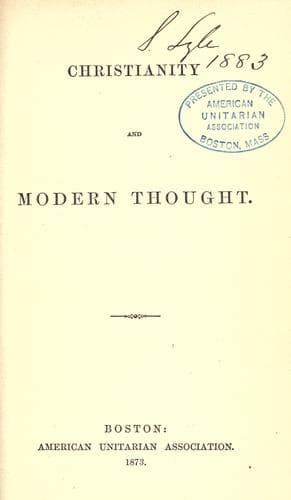
Christianity and Modern ThoughtPeabody, Andrew P. (Andrew Preston)
Religion
Christianity and Modern Thought
Peabody, Andrew P. (Andrew Preston)
Unitarianism
We can best answer this question by considering what is implied in
existence. Existence implies properties, and properties are fitnesses.
Every object, by virtue of its existence, has its place, purpose, uses,
relations. At every moment, each specific object is either in or out of
its place, fulfilling or not fulfilling its purpose, subservient to or
alienated from its uses, in accordance or out of harmony with its
relations, and therefore in a state of fitness or of unfitness as
regards other objects. Every object is at every moment under the control
of the intelligent will either of the Supreme Being or of some finite
being, and is by that will maintained either in or out of its place,
purpose, uses, and relations, and thus in a state of fitness or
unfitness as regards other objects. Every intelligent being, by virtue
of his existence, bears certain definite relations to outward objects,
his fellow-beings, and his Creator. At every moment each intelligent
being is either faithful or unfaithful to these relations, and thus in a
state of fitness or unfitness as regards outward objects and other
beings. Thus fitness or unfitness may be predicated at every moment of
every object in existence, of the volitions by which each object is
controlled, and of every intelligent being with regard to his voluntary
position in the universe. Fitness and unfitness are the ultimate ideas
that underlie the terms _right_ and _wrong_. These last are metaphorical
terms: right, _rectus_, straight, upright, according to rule, and
therefore _fit_; wrong, _wrung_, distorted, twisted out of place,
abnormal, and therefore _unfit_. We are so constituted that we cannot
help regarding fitness with esteem and complacency; unfitness, with
disesteem and disapproval, even though we ourselves create it or
impersonate it.
Fitness is the law by which alone we have the knowledge of sin, by which
alone we justify or condemn ourselves. Duty has fitness for its only aim
and end. To whatever object comes under our control its fit place or use
is due; and our perception of that _due_ constitutes our _duty_, and
awakens in us a sense of obligation. To ourselves and to other beings
and objects, our fidelity to our relations has in it an intrinsic
fitness; that fitness is their and our due; and the perception of that
_due_ constitutes our _duty_, and awakens in us a sense of obligation.
Public-domain text, read in full here on John Shaqi.
Reviews
Reviews
No reviews yet
Be the first to share your thoughts on this work.
Elsewhere in the archive
Join the Discussion
Join the discussion
Sign in to leave a comment or review.
Sign InorCreate an account