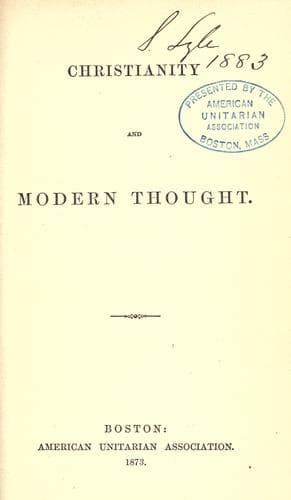
Christianity and Modern ThoughtPeabody, Andrew P. (Andrew Preston)
Religion
Christianity and Modern Thought
Peabody, Andrew P. (Andrew Preston)
Unitarianism
1. _Human brotherhood._ The visible differences of race, color, culture,
religion, customs, are in themselves dissociating influences. Universal
charity is hardly possible while these differences occupy the
foreground. Slavery was a natural and congenial institution under Pagan
auspices, and the idea of a missionary enterprise transcends the
broadest philanthropy of heathenism. We find indeed in the ancient
moralists, especially in the writings of Cicero and Seneca, many
precepts of humanity toward slaves, but no clear recognition of the
injustice inseparable from the state of slavery; nor have we in all
ancient literature, unless it be in Seneca (in whom such sentiments
might have had more or less directly a Christian origin), a single
expression of a fellowship broad enough to embrace all diversities of
condition, much less of race.[16] Even Socrates, while he expects
himself to enter at death into the society of good men, and says that
those who live philosophically will approach the nature of the gods,
expresses the belief that worthy, industrious men who are not
philosophers will, on dying, migrate into the bodies of ants, bees, or
other hard-working members of the lower orders of animals.
[Footnote 16: The verse so often quoted from Terence, "Homo sum; humani
nihil a me alienum puto," will probably occur to many as inconsistent
with my statement. The sentiment of this verse is, indeed, as it stands
by itself, truly Christian; but in the Comedy from which it is quoted,
so far from having a philanthropic significance, it is merely a
busy-body's apology for impertinent interference with the concerns of
his neighbor.]
The fraternity of our entire race--even without involving the mooted
question of a common human parentage--is through Christianity
established, not only by the Divine fatherhood so constantly proclaimed
and so luculently manifested by Jesus, but equally by the unifying
ministry of his death as a sacrifice for all, and by his parting
commitment of "all the world" and "every creature" to the propagandism
of his disciples. Though the spirit of this revelation has not yet been
embodied in any community, it has inspired the life-work of many in
every age; it has moulded reform and guided progress in social ethics
throughout Christendom; it has twice swept the civilized world clean
from domestic slavery; it has shaken every throne, is condemning every
form of despotism, monopoly, and exclusiveness, and gives clear presage
of a condition in which the old pre-Christian division of society into
the preying and the preyed-upon will be totally obliterated.
Public-domain text, read in full here on John Shaqi.
Reviews
Reviews
No reviews yet
Be the first to share your thoughts on this work.
Elsewhere in the archive
Join the Discussion
Join the discussion
Sign in to leave a comment or review.
Sign InorCreate an account