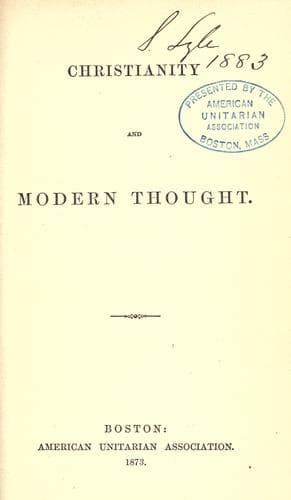
Christianity and Modern ThoughtPeabody, Andrew P. (Andrew Preston)
Religion
Christianity and Modern Thought
Peabody, Andrew P. (Andrew Preston)
Unitarianism
The acme of extra-Christian piety, and consequently of moral excellence,
is presented in the writings and lives of the later Stoics, whose
incorruptible virtue affords the only relief to our weariness and
disgust, as we trace the history of Rome through the profligacy of the
declining commonwealth and the depravity of the empire. We find here the
Simeons and Annas of the Pagan world, who, though with the fleshly arm
they embraced not the Son of God, needed but to see him to adore and
love him. Yet in nothing was Stoicism more faulty than in its exalted
sense of virtue. For it had no charity for sin, no tolerance even for
the inferior forms of goodness. It was the ethics of the unfallen. It
proffered no hope of forgiveness; it let down no helping hand from the
heavens; it uttered no voice from the eternal silence; it opened no
Father's house and arms for the penitent. In Moore's "Lalla Rookh" the
Peri, promised forgiveness and readmission to Paradise on condition of
bringing to the eternal gate the gift most dear to heaven, returns in
vain with the last drop of the patriot's blood. Again, when she brings
the expiring sigh of the most faithful human love, the crystal bar moves
not. Once more she seeks the earth, and bears back the tear of penitence
that has fallen from a godless wretch melted into contrition by a
child's prayer; and for this alone the golden hinges turn. Stoicism
could boast in rich profusion the patriot's blood, could feed the torch
of a love stronger than death; but it could not start the penitential
tear,--it failed of the one gift of earth for which there is joy in
heaven.
Let us rise, then, from the purest philosophy of the old world to
Christianity in its ethical relations and offices.
Christianity, as a revelation, covers the entire field of human duty,
and gives the knowledge of many fitnesses, recognized when once made
known, but undiscoverable by man's unaided insight. The two truths which
lie at the foundation of Christian ethics are human brotherhood and the
immortality of the soul.
Public-domain text, read in full here on John Shaqi.
Reviews
Reviews
No reviews yet
Be the first to share your thoughts on this work.
Elsewhere in the archive
Join the Discussion
Join the discussion
Sign in to leave a comment or review.
Sign InorCreate an account