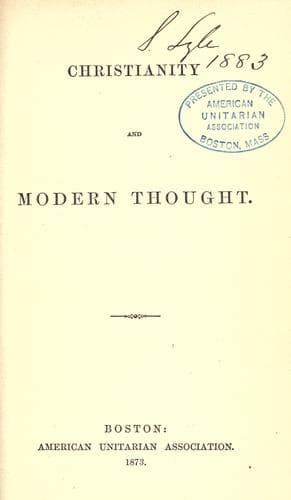
Christianity and Modern ThoughtPeabody, Andrew P. (Andrew Preston)
Religion
Christianity and Modern Thought
Peabody, Andrew P. (Andrew Preston)
Unitarianism
A common factor of the greatest importance enters into the two
conceptions of Christianity just referred to, though not perhaps in
equal measure. I allude to the moral element, which may also be denoted
as the sense of duty,--duty towards God and towards man. It may, indeed,
be said to be a distinguishing glory of Christianity, that it can hardly
exist at all, under whatever outward form, without being more or less
strongly pervaded by the moral spirit of which the ministry of Christ
affords so rich and varied an expression. It is true, however, that the
ritualistic idea has constantly a tendency to degenerate into a mere
care for church observances, devoid of any high tone of uprightness and
purity in the practical concerns of ordinary life. It is a common thing,
in that great religious communion of Western and Southern Europe which
is so strongly animated by this idea, to see people in the churches
ceremoniously kneeling in the act of prayer, while all the time they are
busy, with eager eyes, to follow every movement in the crowd around
them. In certain countries, many of the ritualistically devout, it is
well known, have no scruple in practising the grossest impositions upon
strangers; a statement which is especially true of those lands that in
modern times have been governed and demoralized beyond others by the
influence of the priestly class, with their religion of material
externalities. A Greek or an Italian brigand, it is said, will rob and
murder his captive with a peaceful conscience, provided only that he
duly confesses to the priest, and obtains his absolution. This last is a
gross and, happily, a rare case. But, equally with the more innocent
acts, it illustrates the natural tendencies of ritualistic Christianity
among various classes of persons. In ordinary civilized society, such
tendencies are kept powerfully in check by other influences. Hence it is
not to be denied that, throughout the Christian world, devotional
feeling and the sense of duty are usually deep and active in their
influence, and that the practical teachings of Christ, directly or
indirectly, exercise a potent control, whatever may be the ritualistic
or the dogmatic idea with which they are associated.
The ritualistic conception now spoken of offers us a Christianity which
secures "salvation," by the intervention of a priest,--a man who,
though, to all outward appearance, but a human being among human beings,
yet alleges, and finds people to believe, that he can exercise
supernatural functions, and has the power of opening or closing the
gates of heaven to his fellow-men. It is needless to say how large a
portion of Christendom is still under the influence of this kind of
superstition, or how pertinaciously the same unspiritual form of
religion is, at this moment, struggling to establish itself, even in the
midst of the most enlightened modern nations.
Public-domain text, read in full here on John Shaqi.
Reviews
Reviews
No reviews yet
Be the first to share your thoughts on this work.
Elsewhere in the archive
Join the Discussion
Join the discussion
Sign in to leave a comment or review.
Sign InorCreate an account