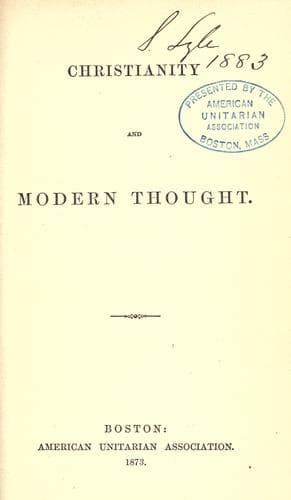
Christianity and Modern ThoughtPeabody, Andrew P. (Andrew Preston)
Religion
Christianity and Modern Thought
Peabody, Andrew P. (Andrew Preston)
Unitarianism
Nor is it necessary here to argue, with any detail, against the notion
of its being either inculcated upon us within the pages of the New
Testament, or enforced by any legitimate authority whatever. Probably
no one who cares to hear or to read these words would seriously maintain
that the Gospel of Christ consists, in any essential way, in submission
to a priesthood, fallible or infallible, in the observance of rites and
ceremonies or times and seasons, or in a particular mode or form of
church government, whatever doctrines these may be supposed to embody or
to symbolize. Such things have, indeed, variously prevailed among the
Christian communities from the beginning. Generation after generation
has seen priests, and Popes, and patriarchs, and presbyters, without
number. These personages have decked themselves out in sacred garments,
assumed ecclesiastical dignities and powers, and sought, many of them,
to heighten the charm and the efficacy of their worship by the aid of
altars and sacrifices, so called, of prostrations, incense, lamps and
candles, and many other such outward accessories. But are such things to
be reckoned among the essentials of Christian faith or Christian
righteousness? Does the presence or the blessing of the Spirit of God,
to the humble, penitent, waiting soul of man, depend upon any thing
which one calling himself a priest can do or say for us? Will any one,
whose opinion is worth listening to, say that it does?
The teaching of Christ and his Apostles is, in truth, remarkably devoid
of every idea of this kind. So much is this the case, that it may well
be matter of astonishment to find men who profess to follow and to speak
for them holding that in such matters there can be only one just and
adequate Christian course,--that, namely, which commends itself to
_their_ judgment! It is evident, on the contrary,--too evident to be in
need of serious argument,--that the very diversities of opinion and
practice which prevail in the world--as expressed by such names as
Catholic and Protestant, Greek Church and Latin Church, Church of
England and Church of Scotland, Episcopalian, Presbyterian,
Congregational--prove conclusively that nothing imperative has been
transmitted to us. The great Christian brotherhood, in its various
sections and diverse conditions, has manifestly been left, in these
things, to its own sense of what it is good and right to follow. Thus,
too, if we will not close our eyes to the plainest lessons of His
Providence, the Almighty Father gives us to understand that He only asks
from us the service of heart and life that is "in spirit and in truth;"
and, consequently, that we may each give utterance to our thoughts of
praise and thanksgiving, to penitence for sin, to our prayer for the
divine help and blessing, in whatever form of words, through whatever
personal agency, and with whatever accompaniment of outward rite and
ceremony we may ourselves deem it most becoming to employ.
Public-domain text, read in full here on John Shaqi.
Reviews
Reviews
No reviews yet
Be the first to share your thoughts on this work.
Elsewhere in the archive
Join the Discussion
Join the discussion
Sign in to leave a comment or review.
Sign InorCreate an account