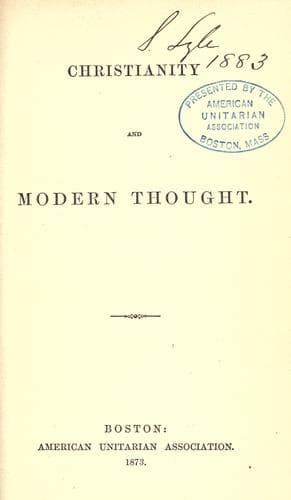
Christianity and Modern ThoughtPeabody, Andrew P. (Andrew Preston)
Religion
Christianity and Modern Thought
Peabody, Andrew P. (Andrew Preston)
Unitarianism
Now the indisputable fact referred to--the existence of this most
serious diversity and opposition of opinion and statement--affords the
strongest reason for considering it an error of the first magnitude to
regard Christianity as essentially consisting in a definite system of
theological dogmas. For is it possible to believe that a divine
revelation of doctrine, such as the Gospel has been so commonly supposed
to be, would have been left to be a matter of doubt and debate to its
recipients? Admitting, for a moment, the idea that the Almighty
Providence had designed to offer to men a scheme of Faith, the right
reception of which should, in some way, be necessary for their
"salvation," must we not also hold that this would have been clearly
made known to them? so clearly, plainly stated as to preclude the
differences just alluded to, as to what it _is_ that has been revealed?
It is impossible, in short, on such an assumption, to conceive of
Christianity, as having been left in so doubtful a position that its
disciples should have found occasion, from age to age, in councils and
assemblies and conferences, in books and in newspapers, to discuss and
dispute among themselves, often amidst anger and bitterness of spirit,
upon the question of the nature or the number of its most essential
doctrines. Of all possible suppositions, surely this is the least
admissible, the most extravagantly inconsistent with the nature of the
case.
To this consideration must be added another, of even greater weight. We
gain our knowledge of Christianity, and of the Author of Christianity,
from the New Testament. And, in this collection of Gospels and Epistles,
it nowhere appears that it was the intention of Christ or of the early
disciples, to offer to the acceptance of the future ages of the world a
new and peculiar Creed, a Confession of faith, a series of Articles of
belief in facts or in dogmas, such as the speculative theologian of
ancient and of modern times has usually delighted to deal with. This is
nowhere to be seen in the New Testament, although it speedily made its
appearance when the Gospel had passed from the keeping of the primitive
church into that of Greek and Hellenistic converts.
Public-domain text, read in full here on John Shaqi.
Reviews
Reviews
No reviews yet
Be the first to share your thoughts on this work.
Elsewhere in the archive
Join the Discussion
Join the discussion
Sign in to leave a comment or review.
Sign InorCreate an account