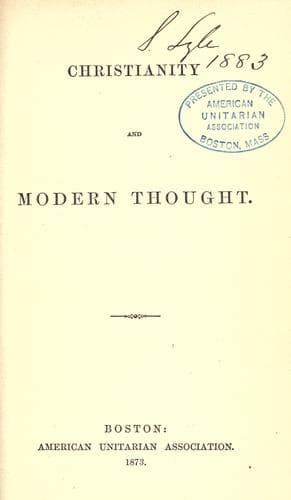
Christianity and Modern ThoughtPeabody, Andrew P. (Andrew Preston)
Religion
Christianity and Modern Thought
Peabody, Andrew P. (Andrew Preston)
Unitarianism
The only thing that can be supposed to approach this character, within
the sacred books themselves, occurs in such phrases as speak of faith in
Jesus Christ, or also of "believing" in the abstract, without any
expressed object. But in none of these instances can a dogmatic creed be
reasonably held to be the object implied or intended. What is meant, is
simply belief in Jesus as the Christ,[18] as may be at once understood
from the circumstances of the case, and may easily be gathered from a
comparison of passages. In the early days of the Gospel, the great
question between the Christians and their opponents was simply this,
whether Jesus of Nazareth was the Christ or not. One who admitted this,
and received him in this character, had _faith_ in him, and might be an
accepted disciple. One who denied and rejected him, as the multitudes
did, was not, and could not be, so accepted. A man could not, in a word,
be a Christian disciple, without recognizing and believing in the
Founder of Christianity.
[Footnote 18: Comp. Matt. xvi. 14-16; Acts ix. 22, xvi. 31; Rom. iii.
22, viii. 6, 9.]
This explanation of the nature of the Faith of the Gospel will be found
to apply throughout the New Testament books. An illustration may be seen
in one of the most remarkable passages, the last twelve verses of St.
Mark's Gospel,--a passage, it should be noted, usually admitted to be of
later origin than the rest of the book. Here (v. 16) we read, "He that
believeth and is baptized shall be saved, but he that believeth not
shall be damned" (condemned). The meaning is explained by a reference to
the related passage, in chapter xxv. of the first Gospel. Here we learn
that at the second Advent, shortly to come to pass, those who, having
received Jesus as Lord, had approved themselves by their works obedient
and faithful disciples, would by him be recognized as his, and admitted
to share in the blessings of the promised kingdom of heaven: those who
had not done so should be rejected and driven from his presence. It is
clear that there is, in such ideas, no sufficient ground for supposing
faith or belief in a creed or a dogma to have been intended by the
writer of either Gospel.
Let me further illustrate my meaning by a brief reference to an ancient
and, by many persons, still accepted formula of orthodox doctrine. This
professes to tell us very precisely what is the true Christian faith. In
plain terms it says, Believe this, and this, and this: believe it and
keep it "whole and undefiled;" unless you do so, "without doubt" you
shall "perish everlastingly."
Public-domain text, read in full here on John Shaqi.
Reviews
Reviews
No reviews yet
Be the first to share your thoughts on this work.
Elsewhere in the archive
Join the Discussion
Join the discussion
Sign in to leave a comment or review.
Sign InorCreate an account