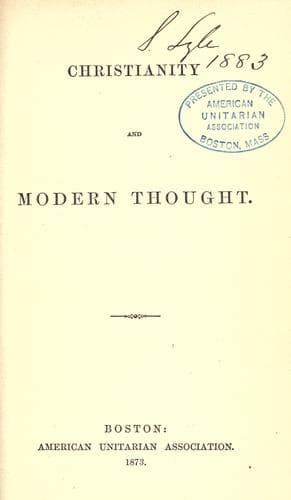
Christianity and Modern ThoughtPeabody, Andrew P. (Andrew Preston)
Religion
Christianity and Modern Thought
Peabody, Andrew P. (Andrew Preston)
Unitarianism
Now my proposition is, that this kind of statement, or any thing like
it, is not to be met with in the teaching of Christ, or in any other
part of the New Testament. Had it been otherwise,--had he plainly said
that the form of doctrine now referred to, or any other, was so
essential, there could have been no room for hesitation among those who
acknowledged him as Teacher and Lord. But he has manifestly not done
this, or any thing like this. Hence, as before, we are not justified in
thinking that the religion which takes its name from him, and professes
to represent his teaching, consists, in any essential degree, in the
acceptance, or the profession, of any such creed or system of doctrine,
exactly defined in words, after the manner of the churches,--whether it
may have come down to us from the remotest times of ante-Nicene
speculation, or only from the days of Protestant dictators like Calvin
or Wesley; whether it may have been sanctioned by the authority of an
[oe]cumenical council, so called, or by that of an imperial Parliament,
or only by some little body of nonconformist chapel-builders, who, by
putting their creed into a schedule at the foot of a trust-deed, show
their distrust of the Spirit of Truth, and their readiness to bind their
own personal belief, if possible, upon their successors and descendants
of future generations.
We may then be very sure that, if the Christian Master had intended to
make the "salvation" of his followers dependent upon the reception of
dogmas, whether about himself or about Him who is "to us invisible or
dimly seen" in His "lower works," he would not have left it to be a
question for debate, a fertile source of angry contention or of
heartless persecutions, as it has often virtually been, _what_ the true
creed, the distinctive element of his religion, really is. The very fact
that this _has_ been so much disputed, that such differences do now so
largely exist before our eyes, forms the strongest possible testimony to
the non-dogmatic character of the primitive or genuine Christianity. The
same fact ought to rebuke and warn us against the narrow sectarian
spirit in which existing divisions originate, and which is so manifestly
out of harmony with "the spirit of Christ."
II.
This absence from the Christian records of all express instruction, on
the subjects above noticed, clearly warrants us in turning away from any
merely dogmatic or ecclesiastical system, if it be urged upon us as
constituting the substance, or the distinctive element of Christianity.
We are thus of necessity led to look for this in something else. But to
what else shall we turn? In what shall we find an answer to our inquiry,
as to the true idea of the Christian Gospel?
Public-domain text, read in full here on John Shaqi.
Reviews
Reviews
No reviews yet
Be the first to share your thoughts on this work.
Elsewhere in the archive
Join the Discussion
Join the discussion
Sign in to leave a comment or review.
Sign InorCreate an account