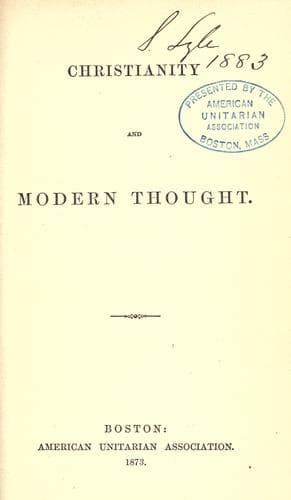
Christianity and Modern ThoughtPeabody, Andrew P. (Andrew Preston)
Religion
Christianity and Modern Thought
Peabody, Andrew P. (Andrew Preston)
Unitarianism
And not only is this so; but, further, it is evidently not through the
_peculiar_ doctrines of his church or sect that a man is most truly
entitled to the name of Christian, but rather by his participation in
what is _common_ to all the churches and sects which are themselves
worthy of that name. For let us call to mind, for a moment, some of the
more eminent Christian men and women of modern times, to whatever
sectarian fold they may have owned themselves to belong. Recall the
names of a Fénelon, an Oberlin, a Vincent de Paul, a Xavier, a
Melancthon, a Milton, a Locke, a Chalmers, a Clarkson, a Wilberforce, a
Mrs. Fry, a Keble, a Heber, a Wesley, a Lardner, a Priestley, a
Channing, a Tuckerman, with innumerable other true-hearted followers of
him who both bear witness to the truth, and "went about doing good." In
such persons we have representatives of nearly all the churches, with
their various peculiarities of doctrinal confession. And must we not
believe that such men and women were true Christians? If so, will it not
follow that in every one of their differing communions true Christians
are to be found? Probably no man, unless it be one of the most bigoted
adherents of Evangelical or high Anglican orthodoxy, would venture to
deny this. There are, then, good Christians, let us gladly admit, in all
the various sects and parties of Christendom; men whom Christ himself,
if he were here, would acknowledge and welcome as true disciples. But
what is it that entitles such persons all alike to the Christian
character and name? It cannot be any thing in which each _differs_ from
the rest, but rather something which they all have in common. It cannot
be any thing that is peculiar to the Roman Catholic alone, for then the
Protestant would not have it; nor any thing that is peculiar to the
Protestant alone, for then the Roman Catholic would not have it; nor any
thing that is peculiar to the Trinitarian alone, for then the Unitarian
would not have it. It must be something apart from the distinctive creed
of each. It is then something which all must possess, otherwise they
would not be truly Christian; which they must have in _addition_ to
their several distinguishing doctrines,--in company with which the
latter may indeed be held, but which is not the exclusive property of
any single church, or sect, or individual, whatever.
Public-domain text, read in full here on John Shaqi.
Reviews
Reviews
No reviews yet
Be the first to share your thoughts on this work.
Elsewhere in the archive
Join the Discussion
Join the discussion
Sign in to leave a comment or review.
Sign InorCreate an account