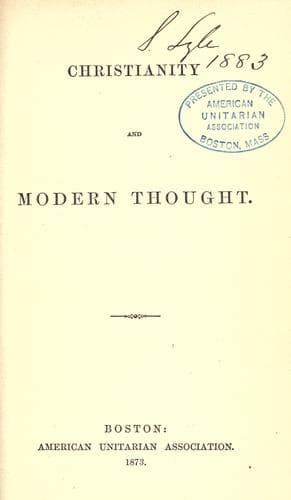
Christianity and Modern ThoughtPeabody, Andrew P. (Andrew Preston)
Religion
Christianity and Modern Thought
Peabody, Andrew P. (Andrew Preston)
Unitarianism
What then do all the Christian sects and parties, of every name, hold in
common, and never differ about? Is it not simply in this, that they
receive and reverence Jesus as the beloved Son in whom God was well
pleased? that they hold the Christian faith in the Father in Heaven,
with all that this involves of love to God and love to man? that they
accept the law of righteousness, placed before us in the "living
characters" of Christ's own deeds and words, and strive to obey it in
their conduct? that they hold the same common faith as to the presence
and the providence of God, the future life and the judgment to come?
This Christian allegiance, it is true, is expressed under the most
different forms of statement, and in many a case it may hardly be
definitely expressed at all; but yet even this, and such as this, is, by
belief and practice, the common property of every Christian man; and so
far as he lives in the spirit of this high faith is he truly a disciple
and no further whatever may be the church or sect, or forms of doctrine
and worship, to which he may attach himself. And all this, I repeat, is
most plainly revealed to us in the spirit and the life of
Christ,--insomuch that we feel the statement to be incontrovertibly
sure, that he is the truest Christian of all whose practical daily
spirit and conduct are the most closely and constantly animated and
governed by the spirit and precepts and example of the Master Christ.
It seems strange, when we think about it, that men should have gone so
far astray, in times past, from the more simple and obvious idea of
Christianity thus laid before us. We may have difficulty in explaining
how this has come to pass; how it is that so much of the weight and
stress, as it were, of the Christian religion should have been laid upon
obscure metaphysical creeds and dogmas, the obvious tendency of which
is, and always has been, to divide men from each other, to degenerate
into gross superstition, and destroy the liberty "wherewith Christ has
made us free," and which, moreover, are nowhere contained in the
Scriptures, and cannot even be stated in the language of the Scriptures;
how it is, again, that so little emphasis should be laid in these
dogmatic formulas upon that obedience which is better than sacrifice,
even that doing the Heavenly Father's will, which--strange to tell!--is
the only condition prescribed by Christ for entering into the kingdom.
Public-domain text, read in full here on John Shaqi.
Reviews
Reviews
No reviews yet
Be the first to share your thoughts on this work.
Elsewhere in the archive
Join the Discussion
Join the discussion
Sign in to leave a comment or review.
Sign InorCreate an account