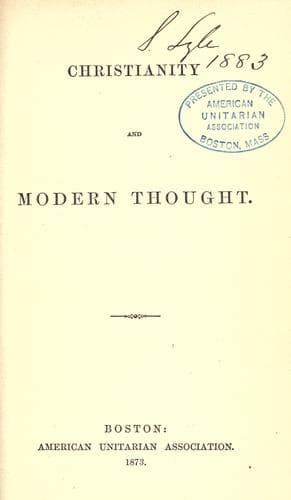
Christianity and Modern ThoughtPeabody, Andrew P. (Andrew Preston)
Religion
Christianity and Modern Thought
Peabody, Andrew P. (Andrew Preston)
Unitarianism
In the first place, it may be said, the idea of the Gospel above
presented is itself dogmatic; and indeed that the conception of
Christianity as involving definite forms of doctrine is not to be got
rid of. This remark I am by no means concerned wholly to escape.
Doubtless the Gospel, as it is given in the words of Christ, includes
various clearly stated truths respecting the Divine Providence and Will,
and the retributions of this world and the next,--truths, I may add,
which are not only level to the apprehension of the human faculties, but
also in harmony with the highest dictates of the natural conscience and
reason of man. But these great truths are not dogmatically laid before
us in the Gospel. The mind of each reader is left free to gather them
for itself. They are so stated as to quicken and elevate, not to stupefy
or render useless, the religious and moral sense of the disciple. They
serve thus, in the result, to arouse in him the strength of deep
individual conviction, without which they could have little practical
value. The teaching function of the Gospel is of _this_ kind, rather
than dogmatic and denunciatory, in the manner of the creeds. It does not
attempt to put before us a ready-made body of doctrine, in such a way as
to save the disciple the trouble of inquiry and reflection for himself,
as though it would make him the mere recipient of what is imposed upon
him from without. Not in this mechanical way, either in the world of
outward nature, or in the Gospel of His Son, does the Great Parent speak
to the hearts of His children; but chiefly by awakening their higher,
devouter sensibilities, and letting them feel the force of truth and
right within their own secret spirits. No imposition from without could
fitly accomplish this divine work; and we may be well assured that no
man living, and no church or sect on earth, has a legitimate authority
to define exactly the limits within which Christian belief shall confine
itself, or beyond which belief shall not extend, without ceasing to be
Christian. Obviously and unquestionably Christ himself has nowhere
attempted to dictate his religion in such a way; neither has any of his
apostles, not even the ardent and impetuous Paul. On the contrary, the
latter, like his Master, constantly attaches the greatest importance to
the practical virtues, and to a devout spirit,--in no case making his
appeal to a dogmatic statement, or giving us to understand that he had
the least idea of any dogmatic system whatever, similar, in spirit or in
form, to the creeds of modern orthodoxy.
Public-domain text, read in full here on John Shaqi.
Reviews
Reviews
No reviews yet
Be the first to share your thoughts on this work.
Elsewhere in the archive
Join the Discussion
Join the discussion
Sign in to leave a comment or review.
Sign InorCreate an account