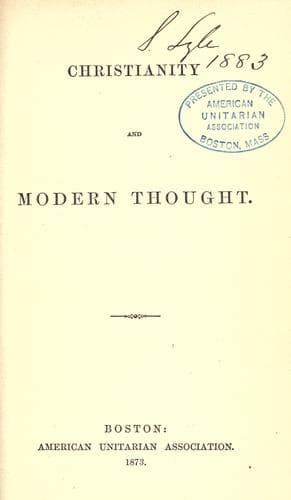
Christianity and Modern ThoughtPeabody, Andrew P. (Andrew Preston)
Religion
Christianity and Modern Thought
Peabody, Andrew P. (Andrew Preston)
Unitarianism
Truly this question is not without its perplexities. But some
explanation may be found. It is the obvious law of Divine Providence, it
is and has been a great law of human progress, that Truth shall not be
flashed upon the mind at once, either in religion or in any other of the
great fields of interest and occupation to man; but that it shall be
conquered and won through the medium of slow and gradual approach, even
in the midst and by the help of misunderstanding and error. It is thus,
doubtless, that men are trained to appreciate rightly the value of the
truths and principles which they ultimately gain. In other words, past
experience goes far to show us that moral excellence and the
apprehension of truth, by such a being as man, can only be acquired by
means of previous conflict with evil and untruth, in some one or other
of their manifold forms; or, if not by an actual personal conflict for
each of us individually, at least by means of the observed or recorded
experience of others, more severely tried than ourselves.
Thus it has doubtless been with the reception and gradual prevalence of
Christian truths and principles. Men have had slowly, by a varied and
sometimes painful experience, to learn that it is not by saying, Lord,
Lord, by confessing some formal creed, or being included within the
limits of some visible church; not by forms and ceremonies of any kind,
such as baptism at the hands of a priest, or the confession of sin into
his ear, that we may become truly recipients of the light and strength
of the Gospel of Christ; but much rather by personal communion with the
Spirit of God, by doing the things which the Lord hath said, by striving
to be like Christ, in heart and in life, active in goodness, submissive
to the Heavenly Father's will, and ready to the work of duty which He
has given us to do.
In proportion as this conception of Christianity comes forward into
view, and assumes the pre-eminence to which it is entitled, and which is
either implied or expressly declared in the principal writings of the
New Testament, in the same degree must the merely dogmatic and
sacerdotal idea sink into insignificance. It will be seen that moral and
spiritual likeness to the Christian Head is what is all-important; and,
consequently, that within the limits of the same communion, bound
together by the common principle of Christian faith,--the principle of
love and reverence for the one Master, Christ,--there may exist the most
complete mental freedom, and even, to a very large extent, the most
diverse theological beliefs.
IV.
But here I may be met by certain objections which will hardly fail to
occur to different classes of readers.
Public-domain text, read in full here on John Shaqi.
Reviews
Reviews
No reviews yet
Be the first to share your thoughts on this work.
Elsewhere in the archive
Join the Discussion
Join the discussion
Sign in to leave a comment or review.
Sign InorCreate an account