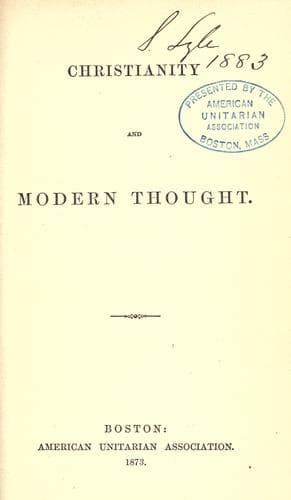
Christianity and Modern ThoughtPeabody, Andrew P. (Andrew Preston)
Religion
Christianity and Modern Thought
Peabody, Andrew P. (Andrew Preston)
Unitarianism
teachings; and whoever slighted it would be the least in the kingdom of
heaven. There is not a word which can be fairly construed into
commendation of the Levitical priesthood. He gives to the Mosaic
precepts cited the most spiritual interpretation, or sets them aside
when they cannot be wrought into a more profound system of natural
morality. He implies his superiority to all preceding teachers,
including Moses. "It was said to the ancients, but _I_ say unto you."
Indeed, his tone in this discourse is any thing but that of a Jewish
Rabbi of his period. It is that of the most human and universal
teaching. It asserts, when we penetrate beyond the immediate occasion of
it to its principle, that which is true in all times and places. Those
affirmations with which it opens, what are they but declarations, the
substantial verity of which it is possible for every man, if he know not
now, yet sometime to know in himself. "Blessed are the poor in spirit:
for theirs is the kingdom of heaven." The spirit of those who can set a
limit to their wants and curb ambition, who do not live blinded by
interests to the demands of a pure soul,--the spirit of such is always
blessed. Happy he who imbibes it from the circumstances of his life; and
happy he who, amidst the blandishments of riches, is taught it by the
discipline of Heaven. These are they to whom has come the kingdom of
heaven from Jesus' day until now. Then, "Blessed are the pure in heart:
for they shall see God." And is not a pure mind the very moral
atmosphere in which man sees God as he is, and rejoices in the sight? A
man's moral sentiments are the medium through which comes to him the
thought of God. Let those sentiments be perverted, and he imagines
either that God is not or that he is different from what he is. His
wrong mind either obstructs entirely the beam which darts from the
Divine essence, or scatters the spotless white of that Sun, the pure
aggregate of Divine perfections, into the particolored tints of the
earthly and sensual soul itself. Again, "Blessed are the merciful: for
they shall obtain mercy." It is even so. Those who sympathize with
human wants will feel the sympathy of God flowing into their souls, and
can never lack assurance of the Divine mercy so long as they keep in
themselves that pledge of it,--the merciful spirit. And so it is a grand
caution, which every one who has wantonly condemned others knows he
ought to keep in memory,--"Condemn not, lest ye be condemned." For the
undeserved, heavy sentence of condemnation which a man lifts high to
hurl with malignant intent at his brother is arrested by an interposing
law of Providence, and falls from his weak hand with its full weight
upon his own head. And at length we come to what might be thought a
studied satire upon the boasted maxims of human wisdom: "Blessed are ye
when men shall speak evil of you falsely for my sake." Is this the sober
truth? Is not Christ, so true elsewhere, mistaken here? It is a verity
Public-domain text, read in full here on John Shaqi.
Reviews
Reviews
No reviews yet
Be the first to share your thoughts on this work.
Elsewhere in the archive
Join the Discussion
Join the discussion
Sign in to leave a comment or review.
Sign InorCreate an account