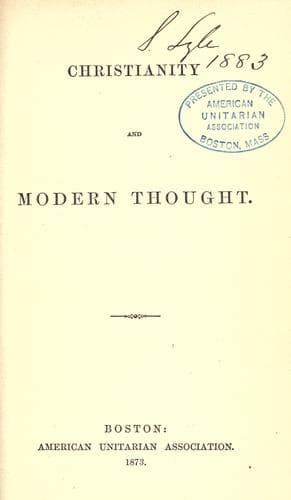
Christianity and Modern ThoughtPeabody, Andrew P. (Andrew Preston)
Religion
Christianity and Modern Thought
Peabody, Andrew P. (Andrew Preston)
Unitarianism
as certain as the laws of God. Do not minds advance unequally in truth,
in all the successive phases of a soul's spiritual growth? Whoever goes
before others in thought and life will find men laying this to his
charge. But, if by following the command of Christian truth to his
conscience he has opened upon himself the battery of human
censoriousness, he may exult; for every unjust word or groundless
suspicion will but remind him of his unbribed devotion, and be changed
before it touches his deepest happiness into the benediction of God.
Were we to go through what was spoken on the Mount, we might show its
truth commanding unquestionably the assent of our moral natures. It all
takes hold of our mind and life. It comes to us to throw light on what
we do and suffer, and to borrow confirmation from it in turn. Though we
fall so far short of it, and could not have conceived it originally and
from ourselves, as Jesus did, it so accords with the laws of our being
as to seem to be the suggestion of our experience, some admonition
floating to us by intent of God on that ever-heaving sea of life, of
ambition, of passion, of mutual misunderstanding, of strong loves and
piercing griefs, of various mingling sympathies, on whose shore we do
now stand, and whose tide, for our few seconds here in time, laves our
feet and dashes upon us its spray.
We might turn over other pages of Jesus' instruction beyond that
introductory statement of the principles of the kingdom of God, and
evolve its sense in terms presenting an undeniable spiritual fact to all
our race. For instance, "To him who hath shall be given, and he shall
have abundance; but from him that hath not shall be taken away, even
that which he seemeth to have." How true! It is verified in the mental
condition of every man at this moment. We only seem to have the faculty
we do not use. There is no long, healthy sleep to the mind and the moral
will any more than to the body; but the alternative is, live or die. And
thus Jesus was ever holding up the law of the spiritual life to the
light of that day which dawned with his advent. He dwelt on what is
inward. Although you cannot find that once, in his popular teaching, he
laid stress upon observances, times without number he studiously
distinguished between every thing of the nature of ceremonial and those
everlasting obligations of justice and humanity, of inward and outward
purity, which ought to be recognized in the home and in the state, in
all the intercourse of man with man, and in watching over the secret
heart. We may not infer that he was hostile to religious forms. He
observed them. He knew that man needed them, and that souls instinct
with life would perpetuate them and adapt them to their own wants. But
he saw in the spirit of the Scribes the evil of teaching that any
arbitrarily imposed outward act can in itself please God; and, in regard
to such, the whole emphasis of his teaching was, "These ought ye to have
Public-domain text, read in full here on John Shaqi.
Reviews
Reviews
No reviews yet
Be the first to share your thoughts on this work.
Elsewhere in the archive
Join the Discussion
Join the discussion
Sign in to leave a comment or review.
Sign InorCreate an account