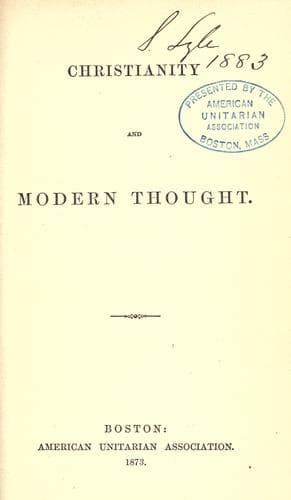
Christianity and Modern ThoughtPeabody, Andrew P. (Andrew Preston)
Religion
Christianity and Modern Thought
Peabody, Andrew P. (Andrew Preston)
Unitarianism
[Footnote 39: See Renan's Life of Jesus, first edition.]
II. The second objection to this view is that it is incompatible with
the most important expressions and opinions of Jesus.
1. The kingdom is to come with the world-catastrophe; and the King is
then to come in some mysterious manner on the clouds of heaven. How,
then, could Jesus say the kingdom of God cometh not with _observation_?
Could any political kingdom arise in a more outwardly striking manner?
How does that saying of Christ comport with his promising a literal
miraculous light in the heaven (Matt. xxiv. 30) which shall betoken his
own coming and the great world-change? That form of coming with a
precursive sign in the heaven is just what he contradicted. Such a
kingdom would come with a sign which could be watched for,--a sign very
different from those signs of the time, the moral indications, which a
spiritual insight might discern. How could he say the kingdom of God was
among them _already_, if it were yet to come at the time of the great
world-change? How could he say to Caiaphas: "Yes, I am the Messiah; and
moreover _from this moment_ you shall see the Son of Man sitting on the
right hand of power and coming on the clouds of heaven"? It was
equivalent to saying, "You have arrested me, you have already doomed me
to death. But I am the Anointed of God to introduce the new spiritual
kingdom of Humanity; and, from this moment in which you decree my death,
my cause takes a Divine impulse, and my purpose strides on to the
triumph God has destined for it."
Public-domain text, read in full here on John Shaqi.
Reviews
Reviews
No reviews yet
Be the first to share your thoughts on this work.
Elsewhere in the archive
Join the Discussion
Join the discussion
Sign in to leave a comment or review.
Sign InorCreate an account