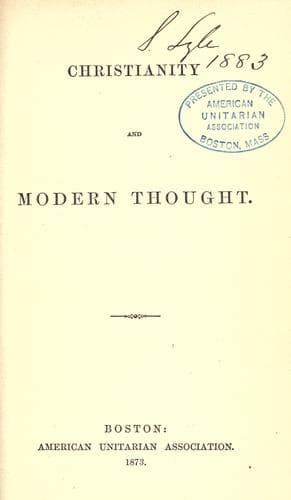
Christianity and Modern ThoughtPeabody, Andrew P. (Andrew Preston)
Religion
Christianity and Modern Thought
Peabody, Andrew P. (Andrew Preston)
Unitarianism
2. This expectation is incompatible with what he says on other topics
related to the kingdom, the resurrection, and the future life. This
expectation implies the Apocalyptic view of the resurrection. The
Messiah was to come to raise the dead. (The Christian world has
generally entertained the same view.) The visible return and the
resurrection coexisted, probably, in Jesus' mind. If he held the one, he
held the other. The two opinions were Siamese twins, connected by a
vital bond; separate them and you would kill them both. But Jesus gave a
view of the resurrection and the future life totally different from the
Apocalyptic one. He taught the _continuance_ of life. His argument with
the Sadducees proves that doctrine, or it amounts to nothing. God is the
God not of the dead, but of the living. The Rich Man and Lazarus, of the
parable, are already in a future state of retribution. He who believes
on him has "already passed from death unto life." Jesus could not
suppose that one who had received from him the quickening of spiritual
life could pass into the under-world, and grope as a shade in the
intermediate state. "Whosoever liveth and believeth in him shall never
die." Now, to one who is satisfied that Jesus was emancipated from the
doctrine of an intermediate state, it must be evident that he could not
have held the Apocalyptic notion resting on it of a raising of the dead
at the coming of the Messiah, and could not have held to the visible
coming of the Messiah who was to come to do that very thing.
The same observation is to be made of the judgment. Jesus shows himself
emancipated from the common notion of the judgment, and of a future
simultaneous judgment-day. He that believeth on him is not judged. He
that believeth not is judged already, in that he has not believed in the
only-begotten Son of God. God sent him not to judge or to punish the
world, but to save it. The judgment of the world is not to be
exclusively at a remote day. It has begun. It is _now_. Christ says, Now
is the judgment of this world; now is the Prince of this world to be
cast out; now, when Jesus is about to consummate by dying the moral
means of that result. Jesus is not to be a personal Judge of men at a
remote time. His principles are for ever to judge men, to judge them
finally. Not himself as the personal Logos, or as the reappearing
Messiah, is to judge men, but "the word he has spoken." These thoughts
in the fourth Gospel must have come from Jesus, not from the writer, who
shows himself in places not emancipated from the view of his time.
Public-domain text, read in full here on John Shaqi.
Reviews
Reviews
No reviews yet
Be the first to share your thoughts on this work.
Elsewhere in the archive
Join the Discussion
Join the discussion
Sign in to leave a comment or review.
Sign InorCreate an account