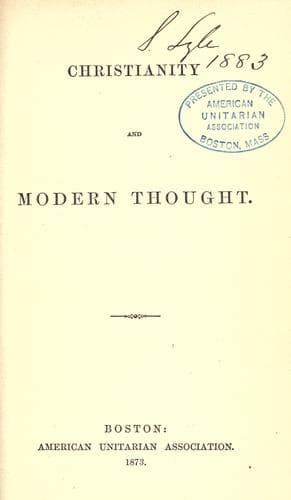
Christianity and Modern ThoughtPeabody, Andrew P. (Andrew Preston)
Religion
Christianity and Modern Thought
Peabody, Andrew P. (Andrew Preston)
Unitarianism
[Footnote 40: Réville, Review of Renan's Life of Jesus.]
These are the principal reasons which determine me to believe that Jesus
did not expect to return visibly to raise the dead, judge the world, and
be the head of an external Theocratic kingdom on the renewed earth.
What, then, shall be said of the language which appears to express that
opinion? "Ye shall drink the wine new with me in my Father's kingdom."
"Ye shall sit on thrones judging the twelve tribes of Israel," &c. Two
considerations are to be kept in sight in establishing the views and
expectations of Jesus: first, that he used this language--so far as he
used it--in a figurative sense, to represent spiritual and providential
facts as he conceived them; second, that the evangelists may have
sometimes given to his language a precision and a connection which did
not belong to it, as delivered. That he could not have employed this
language as it is reported to us, in its literal and proper sense, is to
my mind a necessary conviction in the premises. This would suppose that
he entertained two orders of conceptions, which were opposed to one
another, with a clear profound conviction, and gave them as revelations
of God: one his spiritual and rational beliefs; the other his
Apocalyptic beliefs. This supposition is the vice of Renan's seventeenth
chapter. The language of the Apocalyptic beliefs Jesus might use to some
extent as a vehicle for conveying the spiritual and rational to others;
and the most explicit language in which he conveyed his spiritual
beliefs, so far as it was retained in their feebler minds, might be
forced into harmony with their traditional opinions. But that in Jesus'
mind, so original, so manifestly filled with fresh thought on every
theme of Providence and man, these spiritual apprehensions of a kingdom
or communion of God which should act under and within the state,
renovating human life and society; of a Messiah who by such a kingdom
should fulfil the missionary function of Israel to the race of man; of a
resurrection which should be the uninterrupted continuance of the
blessed life, or an immediate renewal of the sense of wasted opportunity
and law violated on earth; of a judgment both immediate and continual of
every soul despising the truth revealed to it; of a retribution to civil
societies according to Divine law,--should arise as original
conceptions, be held with firm decisive grasp, be of the essence of his
instruction, and so pronounced in him that our most advanced modern
thought is but the distant echo of his profound and distinct
enunciations; and that at the same time he should hold those Apocalyptic
traditions, of a visible coming, of a Theocratic throne before whose
splendor that of Cæsar would fade away, of a simultaneous resurrection
and judgment,--hold them in unimpaired conviction, as truths to be
solemnly insisted upon as a part of his revelation,--this, it seems to
me, comes as near a psychological contradiction as we can well conceive.
Public-domain text, read in full here on John Shaqi.
Reviews
Reviews
No reviews yet
Be the first to share your thoughts on this work.
Elsewhere in the archive
Join the Discussion
Join the discussion
Sign in to leave a comment or review.
Sign InorCreate an account