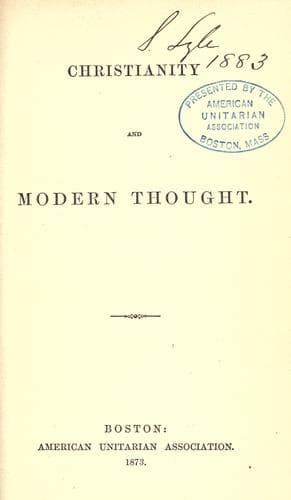
Christianity and Modern ThoughtPeabody, Andrew P. (Andrew Preston)
Religion
Christianity and Modern Thought
Peabody, Andrew P. (Andrew Preston)
Unitarianism
And besides, if Jesus had clung to those beliefs as Divine convictions,
the language ascribed to him would have had the unity of that of the
Epistles and the Apocalypse on this subject. We should not be perplexed
with apparent contradictions. As it is, we are obliged to use those
words which inculcate his spiritual thought for explaining that part of
his language which is conformed to Jewish conceptions.
But, it is said, this language would naturally create misunderstanding,
and that it is too bold to be taken in a figurative sense. In regard to
the misunderstanding of it, let it be said, if we suppose a mind
inspired by God to see far deeper and further than its contemporaries,
it must be liable to be misunderstood in proportion to the poverty of
the vernacular language. Jesus' inspiration and insight gave his speech
a character such as the highest poetic endowment always gives, and made
it bold. It is not to be forgotten that he belonged to the east and to
the people who have given us the Old Testament prophecies. The boldest
tropes were natural to him. In moments of strong moral excitement, they
fly from him as sparks from the flint or lightning from the charged
cloud. It exposes him to the charge of mysticism. We forget that he was
not a lecturer, a systematic teacher; but a prophet, a converser in the
streets, a popular teacher, a poet sent from God to re-create humanity.
Necessity concurred with inspiration to make his speech tropical and
often liable to be misapprehended. He was obliged to use images and
terms which the people and the schools applied to the Messiah in order
to claim, as he meant to claim, a predetermined, providential connection
with Hebrew history and hope. When he said to Pilate, "I am a king," it
was a truth; but it was a trope. "I am the bread of life,"--a truth, but
a trope. "I am come to send a sword on the earth, not peace;" "This cup
of wine is my blood sealing the new covenant,"--truths, but compact with
the boldest tropes. When he said, "I am the Messiah," it was a truth,
but a trope. It was liable to be misunderstood; but, without it, it was
impossible that he should be understood. He saw Satan, after the seventy
returned from their mission and related their success, "falling like
lightning from heaven." If he foresaw political revolutions which would
occur within a generation, and believed they would be employed by
Providence to further the establishment of his principles or kingdom,
which would then reach a point from which it would be evident, to a
sympathizing mind quick to catch the glimpses of a new day, that they
would become dominant in humanity, would it be too bold a figure for him
to say, "The coming of the Son of Man will be as the lightning which
shoots from horizon to horizon," or too bold a figure to describe those
precursive overturns and downfalls of the old in language borrowed from
Isaiah and Joel, the prophets whom he loved and knew by heart? Might he
Public-domain text, read in full here on John Shaqi.
Reviews
Reviews
No reviews yet
Be the first to share your thoughts on this work.
Elsewhere in the archive
Join the Discussion
Join the discussion
Sign in to leave a comment or review.
Sign InorCreate an account