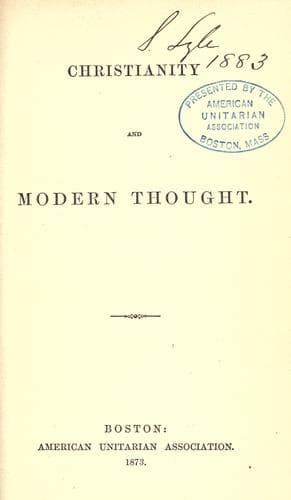
Christianity and Modern ThoughtPeabody, Andrew P. (Andrew Preston)
Religion
Christianity and Modern Thought
Peabody, Andrew P. (Andrew Preston)
Unitarianism
not believe, identifying his religion and the Divine spirit which would
spread it, that at the time of these changes, conspiring providentially
with the labors of apostles and evangelists, his voice would call the
chosen, those prepared by mental and moral affinity, to the new
life-work, to the new order of things; that his call to his own would be
like the supposed call of the last trumpet summoning them to come into a
spiritual communion of blessed work, and blessed hope? These figures
were naturally, almost inevitably, formed in these circumstances.
He used the language given him in the speech of his time in a figurative
sense, partly because of the want of proper terms suited to his purpose,
and partly because as a popular teacher, desirous to impress the common
mind, he could not sacrifice all the associations connected with that.
But we often find in proximity with it words of his own, or something in
the occasion, which he might expect to constrain the listeners to
reflect that he was speaking figuratively; as John vi., "My words, they
are spirit and they are life," and the reply Luke xxii. 38, to the
information, here are two swords, "It is enough." Were the accounts more
full, it is fair to suppose we might have more such expressions. They
would not be so likely to be remembered as the striking, figurative
words.
There are words of Christ at the Last Supper which seem to me to have
occasioned quite unnecessary perplexity. "I say unto you I will not
henceforth drink of the fruit of the vine until that day when I drink it
new with you in my Father's kingdom." They were the spontaneous outflow
of mingled sadness, affection, and hope. He might expect them to be
interpreted to his disciples by his situation, by all he had said of
leaving them, and by his habit of conveying spiritual thought under the
sensuous images suggested by the moment. They referred to the kingdom he
died to establish. They were as natural as to say, "Where two or three
are gathered together in my name, there am I in the midst of them." But
they have been a stumbling-block to students whom we should have
expected to be able better to _orient_ themselves in the Master's genius
and style.
Public-domain text, read in full here on John Shaqi.
Reviews
Reviews
No reviews yet
Be the first to share your thoughts on this work.
Elsewhere in the archive
Join the Discussion
Join the discussion
Sign in to leave a comment or review.
Sign InorCreate an account