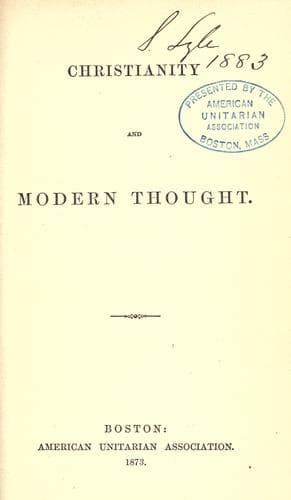
Christianity and Modern ThoughtPeabody, Andrew P. (Andrew Preston)
Religion
Christianity and Modern Thought
Peabody, Andrew P. (Andrew Preston)
Unitarianism
Algebra. We received from them our numerical characters. We all know the
beauty and permanence of their architecture, and much of our musical
knowledge is derived from them. They also made great progress in
scientific agriculture and horticulture, in mining and the working of
metals, in tanning and dying leather. Damascus blades, morocco,
enamelled steel, the manufacture and use of paper, the use of the
pendulum, the manufacture of cotton, public libraries, a national
police, rhyme in verse, and our arithmetic, all came to us from the
Arabs.
All this fruitful intellectual life must be traced directly back to the
theological impulse given by Mohammed to the Arab mind; for it can be
derived from no other source.
It is not quite so easy to define the precise influence on human
progress given by the doctrines of the Reformation; for, before Luther,
these were in the air. But no one can reasonably doubt that the demand
for freedom of conscience and the right of private judgment in religion
has led to liberty of thought, speech, action, in all other directions.
To the war against papal and ecclesiastical authority in concerns of the
soul we owe, how much no one can say, of civil freedom, popular
sovereignty, the emancipation of man, the progress of the human mind.
The theses of Luther were the source of the Declaration of Independence.
And modern science, with the great names of Bacon and Newton, Descartes
and Leibnitz, Goethe and Humboldt, is the legitimate child of Protestant
Theology.
It is true that printing and maritime discoveries preceded Luther. But
these inventions came from the same ideas which took form in the
Lutheran Reformation. The discovery of printing was a result, no less
than a cause. It came because it was wanted; because men were wishing to
communicate their thoughts more freely and widely than could be done by
writing. If it had been discovered five hundred years before, it would
have fallen dead, a sterile invention, leading to nothing. And so the
steam-engine and the railroad did not come before, because they were not
wanted: as soon as they were wanted they came. That which lies at the
root of all these inventions is the wish of man to communicate easily
and rapidly and widely with his brother-man; in other words, the sense
of human brotherhood. Material civilization, in all its parts and in all
times, grows out of a spiritual root; and only faith leads to sight,
only the things unseen and eternal create those which are seen and
temporal.
Public-domain text, read in full here on John Shaqi.
Reviews
Reviews
No reviews yet
Be the first to share your thoughts on this work.
Join the Discussion
Join the discussion
Sign in to leave a comment or review.
Sign InorCreate an account