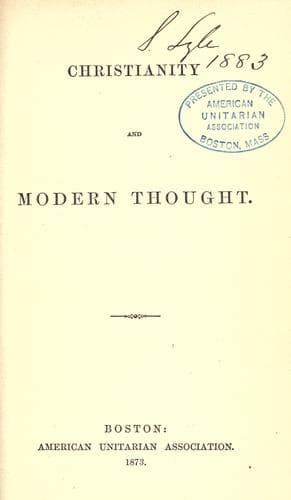
Christianity and Modern ThoughtPeabody, Andrew P. (Andrew Preston)
Religion
Christianity and Modern Thought
Peabody, Andrew P. (Andrew Preston)
Unitarianism
I think, however, the changes that have taken place have not altered the
essential character of the Roman Church. I think the changes that have
happened are in conformity with the nature of that church; really were
to be expected, and have nothing absolutely new in them. We might,
perhaps, for a long time have seen them coming; and, if we had had
foresight enough, we might have seen them from the very first times of
that church. Let us try to understand exactly what she is, what she
means; let us try to see what there is under that name, "Roman Catholic
Church." She calls herself _catholic_, which means _universal_, and at
the same time she has a local name. She is for the whole world; but at
the same time she belongs to one city, and she bears the name of that
city. Why? This is the question; and though it seems only a question of
name, I think we shall find by other ways that it is a question of
facts. A second advance requires a change in our polemics with Roman
authority. A new science has been created in our time, which gives us
better means of judging and studying other churches than our own; that
science is called the comparative history of religions. In England Max
Müller, in France Burnouf, and in this country James Freeman Clarke,
have compared the history of several religions. According to that
comparative history, there are rules to be understood, to be
acknowledged, in the development of religion. One of the rules which I
think we can deduce from any comparative history of religion may be a
startling one; and I will use a very homely comparison, to make myself
perfectly understood. Have you ever seen over a shop door a sign-board,
where the name of the old shop-keeper was painted; and, when his
successor came in, he had the same board covered with a new color, and
his own name painted over the old one? But in time the new paint wore
off, so that the old name reappeared under the new, in such a way that
it became perhaps difficult to distinguish clearly which letters or
lines belonged to the old, and which to the new. If this image appears
somewhat too familiar, let me ask you if you remember what scholars call
a palimpsest. Sometimes in the Middle Ages it was difficult to find
well-prepared parchment on which to write, and there were a great many
monks who had nothing else to do--and it was the best use they could
make of their time--but write or copy the Bible or other religious
books. When they found parchments where were copied the comedies and
tragedies or other works of the heathen, they thought those were of very
little use, and they could very easily have the writing on those
parchments washed out, or covered over with white paint, in such a way
that what had been written there was no more visible. Then on those
parchments they would write the Bible, or sermons, or any document they
thought useful. But the same thing happened then that happened with the
Public-domain text, read in full here on John Shaqi.
Reviews
Reviews
No reviews yet
Be the first to share your thoughts on this work.
Join the Discussion
Join the discussion
Sign in to leave a comment or review.
Sign InorCreate an account