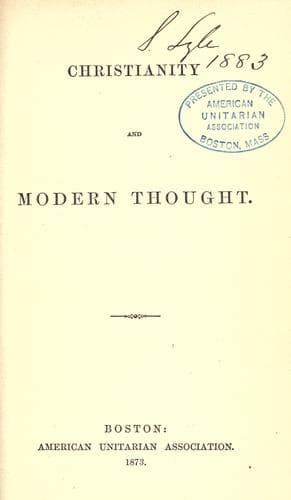
Christianity and Modern ThoughtPeabody, Andrew P. (Andrew Preston)
Religion
Christianity and Modern Thought
Peabody, Andrew P. (Andrew Preston)
Unitarianism
Clearly, it would not do any longer to say that the worth and virtue and
influence of society, in this country, could be estimated by the number
of communicants in the churches, by the degree of credit still given to
any of the long-believed theological dogmas, deemed in the last
generation the sheet-anchors of the State. We all know hundreds of
people, who could sign no creed, and give no theological account of
their faith, whom we do not count as necessarily less worthy in the
sight of God or man than many who have no difficulty in saying the whole
Athanasian Creed. Nay, there are some millions of people in this
country, not the least intelligent or useful citizens in all cases, who
never enter a church-door. A generation or two back, you would safely
have pronounced all these absentees to be worldly, careless people,
infidels, atheists, scoffers. Do you expect to find them so now? Some,
of course, but not the majority. Indeed, you would find a great many of
these people supporting churches, to which their families go, and not
themselves; or to which others go, for whom they are glad to provide the
opportunity. They would tell you, if they could discriminate their own
thoughts, something like this: "Public worship and church organizations,
and creeds and catechisms, and sermons and ceremonies, and public
prayers and praises, are doubtless very good things, and very useful up
to a certain stage of intelligence, and for a certain kind of character.
But we have discovered that the real truth and the real virtue of what
people have been misnaming religion is a much larger, freer, and more
interesting thing than churches, creeds, ministers, and saints seem to
think it. Here is this present life, full of occupations and earnest
struggles and great instructions. Here is this planet, not a thousandth
part known, and yet intensely provoking to intelligent curiosity; and
science is now every day taking a fresh and an ever bolder look into it;
and we want our Sundays to follow these things up. That is our idea of
worship. Then, again, the greatest philosophers are now writing out
their freest, finest thoughts about our nature; and, if we go to church,
we are likely to find some fanatical and narrow-minded minister warning
us against reading or heeding what these great men say; and it is a
thousand times fresher and grander and more credible than what he says
himself! Why, the very newspapers, the earnest and well-edited ones,
contain more instruction, more warning, more to interest the thoughtful
mind, than the best sermons; and why should a thinking man, who needs to
keep up with the times, and means to have his own thoughts free, go
where duty or custom makes it common to frown upon inquiry, doubt, and
speculation,--to shut out knowledge and testimony, and stamp a man with
a special type of thinking or professing?"
Public-domain text, read in full here on John Shaqi.
Reviews
Reviews
No reviews yet
Be the first to share your thoughts on this work.
Join the Discussion
Join the discussion
Sign in to leave a comment or review.
Sign InorCreate an account