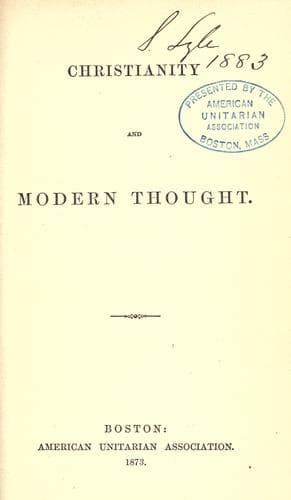
Christianity and Modern ThoughtPeabody, Andrew P. (Andrew Preston)
Religion
Christianity and Modern Thought
Peabody, Andrew P. (Andrew Preston)
Unitarianism
Now, if this were a quarrel between experience and inexperience, between
good and bad, between truth and falsehood, it would be easy to take
sides. But faith and knowledge have both equal rights in humanity.
People who are sincerely in love with knowledge and science and
philosophy are not thereby made enemies of God or man; certainly are not
to be discouraged and abused for their devotion to practical and
scientific truth, their search for facts, their interest in the works of
the Creator, even if they are not possessed of what the church properly
calls faith and piety. And, on the other hand, however shocked
established faith and piety may naturally be by the handling which
religion and its creeds and worship receive from modern inquisitors,
ought the deeper believers to be seriously alarmed for the safety of its
root or its healing leaves, on account of the shaking which the tree of
life is now receiving? However slow science and culture may often show
themselves to be in recognizing the fact, can any reasonable and
impartial mind, acquainted with history or human nature, believe that
faith itself is an inconstant or perishable factor in our nature? prayer
a childish impulse, which clear-seeing manhood must put away? the
conscience, not the representative of a holiness enthroned over the
moral universe, but an artificial organ, which social convenience has
developed, much like the overgrown liver in the Strasburg goose? In
short, who that considers the part that faith and worship have played in
the history of the race, can doubt their essential and permanent place
in human fortunes? The question of _some_ religion, of _some_ worship,
for the people, does not seem debatable. The only alternative among
nations has been a religion in which mystery, awe, and fear prevailed,
clothing themselves in dread and bloody sacrifices, or else a religion
in which more knowledge, more reason, more love, embodied themselves in
a simpler and gentler ritual. The nations have had only a choice--not
always a wholly voluntary one--between terrific superstitions and more
or less reasonable religions. Christianity has prevailed in civilized
nations, since Constantine, by accommodating its theological dogmas and
external ritual to the needs of successive eras; beginning with coarser
and more heathenish symbols, and running itself clearer and more clear,
as the mind and taste and experience of the race have developed
"sweetness and light." But does this make Christianity only a human
growth, and so predict a coming decay, which many seem to think has
already begun? On the contrary, the decisive fact about Christianity is,
that, while its intellectual history is changing, its early records are
in form fixed and permanent, and that its real progress has been
uniformly a return towards its original simplicity. Other faiths
develop. It is we who develop under Christianity, and are slowly changed
unto the original likeness of Christ. Christ's statements, Christ's
Public-domain text, read in full here on John Shaqi.
Reviews
Reviews
No reviews yet
Be the first to share your thoughts on this work.
Join the Discussion
Join the discussion
Sign in to leave a comment or review.
Sign InorCreate an account