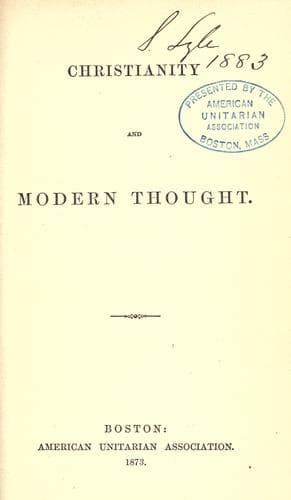
Christianity and Modern ThoughtPeabody, Andrew P. (Andrew Preston)
Religion
Christianity and Modern Thought
Peabody, Andrew P. (Andrew Preston)
Unitarianism
Yet this is constantly done; to the injury of virtue, of conscience, and
of a proper self-respect. In our theories of culture, we demand of
ourselves, what is impossible, what is unjust to ourselves, what
repudiates a part of the very nature we would cultivate. We demand of
ourselves, and we suppose that Christianity demands of us, a certain
unattainable perfection,--or what we call perfection,--a sinking of
ourselves out of sight, and an absorption into the love of God and men,
quite beyond our reach: and failing of that--thinking it entirely out of
our sphere, we give up the proper rational endeavor to be Christians. We
make the highest virtue something exceptional, instead of regarding it
as a prize for us all. We imagine that some few have attained it; that
Jesus did, and that a few persons, denominated _saints_, have approached
him; but that for the common run of men, this is all out of the
question. The fact is, that Christianity is regarded by many, as an
enigma, a secret of the initiated, as an idle vision or hard
exaction--not as a rational culture. Listen to the conversation of the
mart or the drawing-room, you will find that the high Christian law is
but a mocking dream in their eyes. "Giving to him that asketh, and from
him that would borrow, turning not away, and to him that takes from us
our coat, giving our cloak also; and turning the other cheek to the
smiter;"--what is this, they say, but extravagance and fanaticism? As if
they did not know that there is such a figure of speech as hyperbole;
and that it was perfectly natural, in a society where the poor and the
weak were trodden under foot, for the greatest heart that ever was, thus
to pour out itself in pleadings for sympathy, commiseration and
kindness. But the same Master said, "It is profitable for thee--it is
better for thee," to have some of thy pleasures cut off--thine offending
hand or eye; rather _that_, than to have thy whole being whelmed in
misery.
It is really necessary in this matter, not only to vindicate
Christianity as a reasonable religion, but to vindicate human nature to
itself; to save it from the abjectness of feeling that the necessity of
self-help is an ignoble necessity. Men say, "Yes, we are all selfish, we
are all bad;" and they sink into discouragement or apathy, under that
view.
The conditions of true culture are attracting increased attention at the
present time; and it is natural that they should, when men's minds are
getting rid of theologic definitions and assumptions, and are coming to
take broad and manly views of the subject. I am endeavoring to make my
humble contribution to it; and with this view, to show, in the first
place, what part our very selfhood, both of right and of necessity, has
in it.
Public-domain text, read in full here on John Shaqi.
Reviews
Reviews
No reviews yet
Be the first to share your thoughts on this work.
Elsewhere in the archive
Join the Discussion
Join the discussion
Sign in to leave a comment or review.
Sign InorCreate an account