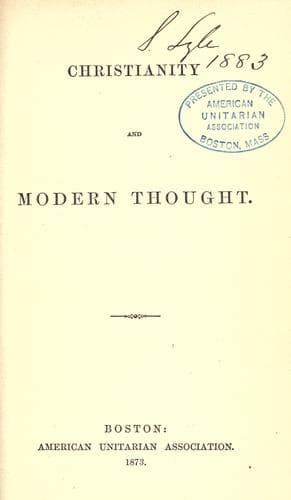
Christianity and Modern ThoughtPeabody, Andrew P. (Andrew Preston)
Religion
Christianity and Modern Thought
Peabody, Andrew P. (Andrew Preston)
Unitarianism
This principle lies in the very roots of our being; and it is developed
earliest in our nature. Before the love of right, of virtue, of truth,
appears this self-regard. Disinterestedness is of later growth. Infancy
comes into the world like a royal heir, and takes possession, as if the
world were made for itself alone. Itself is all it knows; it will by and
by, take a wider range. There is a natural process of improvement in the
very progress of life. "You will get better," says a dramatic
satirist,[7] "as you get older; all men do. They are worst in childhood,
improve in manhood, and get ready, in old age, for another world. Youth
with its beauty and grace, would seem bestowed on us, for some such
reason, as to make us partly endurable, till we have time to become so
of ourselves, without their aid, when they leave us. The sweetest child
we all smile on, for his pleasant want of the whole world to break up,
or suck in his mouth, seeing no other good in it--would be roughly
handled by that world's inhabitants, if he retained those angelic,
infantile desires, when he has grown six feet high, black and bearded;
but little by little, he sees fit to forego claim after claim on the
world, puts up with a less and less share of its good as his proper
portion, and when the octogenarian asks barely for a sup of gruel or a
fire of dry sticks, and thanks you as for his full allowance and right
in the common good of life,--hoping nobody will murder him--he who began
by asking and expecting the whole world to bow down in worship to
him--why, I say, he is advanced far onward, very far, nearly out of
sight."
[Footnote 7: Browning: A Soul's Tragedy, p. 250.]
This advancement, thus springing out of the very experience of life, I
am yet to consider, and have it most at heart to consider. It is of such
priceless worth, it so embraces all that is noble in humanity, that the
importance of the opposite principle, is liable to be quite overlooked.
Selfishness, which is the excess of a just self-regard, is the one form
of all evil in the world. The world cries out upon it, and heaps upon it
every epithet, expressive of meanness, baseness and guilt. And let it
bear the branding scorn; but let us not fail to see, though selfishness
be the satirist's mark, and the philosopher's reproach, and the
theologian's argument, the real nature and value of the principle, from
which it proceeds.
Public-domain text, read in full here on John Shaqi.
Reviews
Reviews
No reviews yet
Be the first to share your thoughts on this work.
Elsewhere in the archive
Join the Discussion
Join the discussion
Sign in to leave a comment or review.
Sign InorCreate an account