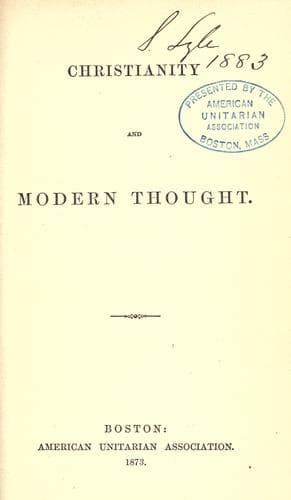
Christianity and Modern ThoughtPeabody, Andrew P. (Andrew Preston)
Religion
Christianity and Modern Thought
Peabody, Andrew P. (Andrew Preston)
Unitarianism
There is another element in this selfhood, to be considered, besides its
conscious importance, and that is free will--itself also unmoral, but
indispensable. For imagine a rational being to be placed in this world,
_without_ free will. He can choose neither wrong nor right. He has a
conscience, but no freedom; no power to choose any thing. It is, I
think, an incongruous and impossible kind of existence; but imagine it.
Evils, troubles, temptations press against this being, and he can do
nothing; he cannot even will to resist. Could there be a condition more
horrible? No; man is a nobler and happier being than this amounts to.
Free will is put in him, on purpose to fight the great battle against
evil. He could not fight, if he could not will. He could not choose the
right, without being free to choose the wrong; for choosing one path
without being at liberty to take the other, would be no choosing. Free
will is to fight the battle. It is a glorious prerogative. And man, I
believe, is out of all proportion, happier, with this power, all its
aberrations included, than he would be without it. I am glad for my
part, that I am not passing through this world, like a car on a
railroad, or turning round like a wheel in a mill; that I can go, this
way or that, take one path or another; that I can read, or write, or
study, or labor, or do business; and that when the great trial-hour,
between right and wrong, comes, though I may choose the wrong, yet that
I _can_ choose the right. What better would there be for me than
this--what better constitution of a rational nature? I know of no better
possible.
Selfhood, then--this interest in ourselves, being seen to be right, and
the play of free will which is a part of it desirable; let us turn
finally to the useful working of the principle. You may have said in
listening to me thus far, "What need of insisting so much upon
self-regard, which we all perfectly well understand?" I doubt whether it
is so well understood; and this must be my apology. We have seen that
the principle is native and necessary to us; let us look a moment, at
its utility.
I am put in charge of myself--of my life, first of all. So strong is the
impulse to keep and defend it, that self-preservation has been called
the first law of our being. But that argues an antecedent
fact--self-appreciation. Why preserve that which we value not? We
defend ourself, because we prize ourself. We defend our life, with the
instant rush of all our faculties to the rescue. "Very selfish," one may
say; "And why does a man care so much for himself; he isn't worth it."
He can't help it. He obeys the primal bond; he is a law to himself. Is
it not well? Man's life would perish in a thousand ways, if he did not
thus care for it. The great, universal and most effective guardianship
over human life everywhere, is--not government nor law, not guns nor
battlements, not sympathy, not society--but this self-care.
Public-domain text, read in full here on John Shaqi.
Reviews
Reviews
No reviews yet
Be the first to share your thoughts on this work.
Elsewhere in the archive
Join the Discussion
Join the discussion
Sign in to leave a comment or review.
Sign InorCreate an account