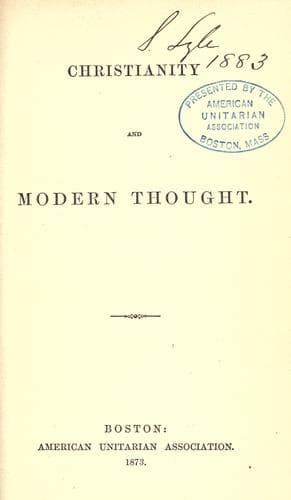
Christianity and Modern ThoughtPeabody, Andrew P. (Andrew Preston)
Religion
Christianity and Modern Thought
Peabody, Andrew P. (Andrew Preston)
Unitarianism
I am put in charge of my own comfort, of my sustenance. I must provide
for it. And to provide for it, I must have property--house, land,
stores, means--something that must be my own, and not another's. If I
were an animal, I might find food and shelter in the common storehouse
of nature's bounty. But I have other wants; if I have no provision for
them that is my own; if some godless International League, or Agrarian
Law, could break down all the rights of property, there would be an end
to industry, to order, to comfort, and eventually to life itself.
Whatever evils, whatever monstrous crimes come of the love of gain, its
extinction would be infinitely worse.
I am put in charge of my good name, my place among men. I must regard
it. I am sinking to recklessness about virtue if I cease to value
approbation. Even the martyr, looking to God alone, seeks approval. And
good men's approbation is the reflection of that. To seek honor from men
at the expense of principle, is what the Master condemns--not the desire
of honor. It has been made a question whether the love of approbation
should be appealed to, in schools. It cannot be kept out, from there,
nor from anywhere else. If it could, if the vast network of social
regards, in which men are now held, were torn asunder, society would
fall to pieces.
Finally, I am put in charge of my virtue--of that above all. And that I
must get and keep for myself; no other can do it for me. Another may
stretch out the hand to defend me from a fatal blow; another may endow
me with wealth; another may give me the praise I do not deserve; but no
friendly intervention, no deed of gift, no flattery, no falsity, can
give me inward truth and integrity. That solemn point in human
experience, that question upon which every thing hangs--shall I do
right?--or shall I do wrong?--is shrouded in the secrecy and silence of
my own mind. All the power in the world, cannot do for me the thing that
I must do for myself. To me, to me, the decision is committed.
Now what I have been saying, is this; it is well that that self-regard,
upon which so much is devolved, should be strong; that there should be
no apathy, no indifference, upon this point; that if ever a man wanders
away into recklessness, into idleness, into disgrace, into utter moral
delinquency and lawlessness, he should be brought to a stand, and
brought back again, if possible, by this intense and uncontrollable
regard for himself--for his own well-being. I do not resolve every thing
in human nature, into the desire of well being. I do not say that the
love of life, of property, of reputation, still less of virtue, is the
same as the love of happiness; but I say that to the pursuit of all
these a man is urged, driven, almost forced, by this love of his own
well-being; nay more to the pursuit of the highest eventually, and that,
by the very laws of his nature.
Public-domain text, read in full here on John Shaqi.
Reviews
Reviews
No reviews yet
Be the first to share your thoughts on this work.
Elsewhere in the archive
Join the Discussion
Join the discussion
Sign in to leave a comment or review.
Sign InorCreate an account