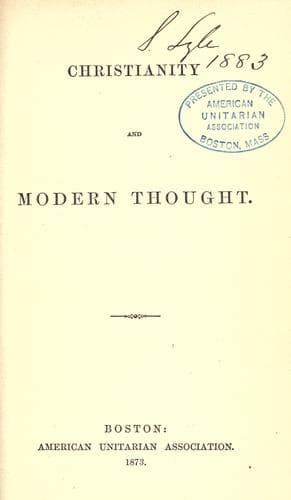
Christianity and Modern ThoughtPeabody, Andrew P. (Andrew Preston)
Religion
Christianity and Modern Thought
Peabody, Andrew P. (Andrew Preston)
Unitarianism
A man's thought starts from himself; but if it stopped there, he would
be nothing. All philosophy, science, knowledge presuppose certain
original faculties and intuitions; but not to cultivate or carry them
out, would leave their possessor to be the mere root or germ of a man. A
line in geometry presupposes a point; but unless the point is extended,
there can be no geometry; it is a point barren of all science, of all
culture.
Every intellectual step is a step out of one's self. The philosopher who
studies _himself_, that he may understand his own mind and nature, is
but studying himself objectively; his very self _then_ lies out of
himself, and is an abstraction to him. And the mathematician, the
astronomer, the naturalist, the poet, the artist, each one goes out of
himself. His subject, his theorem, his picture it is, that draws
him--not reward, not reputation. Doubtless Newton or Herschel, when he
left his diagram or his telescope, and seated himself in the bosom of
his family, might say, "We must live; I must have income; and if public
or private men offer to remunerate and sustain me, it is right that they
should do so." But the moment he plunges into deep philosophic
meditation, he forgets all that. Nature has more than a bridal charm,
science more than golden treasures, truth more than pontifical
authority, to its votaries. Not wooing, but worship, is found at its
shrines and altars. In the grand hierarchies of science, of literature,
of art, there is a veritable priesthood, as pure, as unworldly, as can
be found in any church. It is delightful to look upon its work, upon its
calm and loving enthusiasm. The naturalist brings under his microscope,
the smallest and most unattractive specimen of organized matter, and
goes into ecstasies over it, that might seem ridiculous; but no, this is
a piece of _holy nature_--a link in the chain of its majestic harmonies.
And so every intellectual laborer, when his work is noblest, forgets
himself--the lawyer in his case, the preacher in his sermon, the
physician in his patient. Is it not true then, and is it not noteworthy,
that all the intellectual treasures that are gathered to form the
noblest humanity, all the intellectual forces that are bearing it
onward, come of self-forgetting?
Public-domain text, read in full here on John Shaqi.
Reviews
Reviews
No reviews yet
Be the first to share your thoughts on this work.
Elsewhere in the archive
Join the Discussion
Join the discussion
Sign in to leave a comment or review.
Sign InorCreate an account