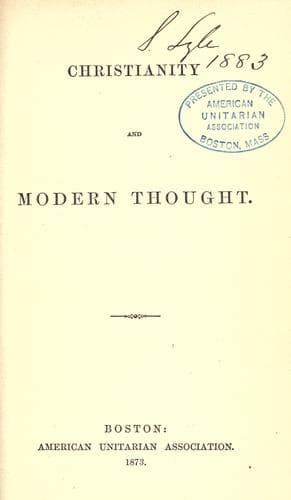
Christianity and Modern ThoughtPeabody, Andrew P. (Andrew Preston)
Religion
Christianity and Modern Thought
Peabody, Andrew P. (Andrew Preston)
Unitarianism
Let us now turn to the other principle which I propose to discuss--that
which opens the whole field of our culture--the principle that carries
us out of, and beyond ourselves.
It has been no part of my design, in discussing the principle of
selfhood, to show the hinderance to culture, and the evil every way,
that come from the abuse of it. That will be sufficiently manifest, if
it be made to appear, that all culture and happiness are found in the
opposite direction. But if I wanted to put this in the strongest light,
I should point to the pain and obstruction which are experienced in a
diseased self-consciousness. It would be a powerful argument for that
going out of self, which I am about to speak of. Self, if it is a
necessary stand-point, is yet liable to be always in our way. A morbid
anxiety about our position, our credit with men, the good or ill opinion
others have of our talents, tastes or merits, causes more misery, I am
inclined to think, than any other form of human selfishness. See a
company of persons, inthralled with music, charmed by eloquence,
transported by some heroic action set before them; and they forget
themselves; they do not think, how they look, how they are dressed, what
others think of them, in their common delight.
The sense of this, I believe it was, that lay at the bottom of the old
Buddhist doctrine of Nirwana--_i.e._, self-oblivion. To lose this
wearisome, diseased self, seemed to Gautama, the great apostle of
Buddhism, to be the chief good. Nirwana has been taken to mean absolute
annihilation. I do not believe the Buddhists meant that; for to me, it
is incredible, that any great sect, numbering millions, should have so
totally given up the natural love of existence, and desire of
immortality; and Max Müller and others have brought that construction
of the Buddhist creed, into doubt. Individuals may go that length.
Unhappy Blanco White, tortured in body and mind, could say that he
desired no more of life, here or hereafter. A German naturalist could
say, "Blessed be the death hour--the time when I shall cease to be." But
this revolt against self and very self-existence, whether ancient or
modern, I advert to, only to show the necessity of going out from it, in
order to build up the kingdom of God within us. It is notable; it is
suggestive; but it is neither healthy, nor true to human nature. Far
truer is that admirable little poem of David Wasson's, originally
entitled "Bugle Notes," which in unfolding the blessing and joy of
existence, touches, I think, the deepest and divinest sense of things.
But let us proceed to consider the law of sacrifice--not sacrifice of
happiness nor improvement, but the finding of both, in going out from
self, to that which is beyond and above it.
Public-domain text, read in full here on John Shaqi.
Reviews
Reviews
No reviews yet
Be the first to share your thoughts on this work.
Elsewhere in the archive
Join the Discussion
Join the discussion
Sign in to leave a comment or review.
Sign InorCreate an account