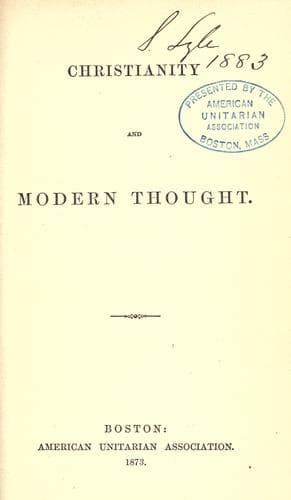
Christianity and Modern ThoughtPeabody, Andrew P. (Andrew Preston)
Religion
Christianity and Modern Thought
Peabody, Andrew P. (Andrew Preston)
Unitarianism
It is no answer to say that the victims of intellectual toil, broken
down in health or fortune, have counted their work, a privilege and joy.
As well deny the martyr's sacrifice, because he has joyed in his
integrity. And many of the world's intellectual benefactors, have been
martyrs. Socrates died in prison, as a public malefactor; for the
healing wisdom he offered his people, deadly poison was the reward.
Homer had a lot so obscure, at least, that nobody knew his birthplace;
and indeed some modern critics are denying that there ever was any
Homer. Plato travelled back and forth from his home in Athens to the
court of the Syracusan tyrant, regarded indeed and feared, but
persecuted and in peril of life; nay, and once sold for a slave. Cicero
shared a worse fate. Dante, all his life knew, as he expressed it,--
"How salt was a stranger's bread,
How hard the path still up and down to tread,
A stranger's stairs."
Copernicus and Galileo found science no more profitable than Dante found
poetry. Shakspeare had a home; but too poorly endowed to stand long in
his name, after he left it; the income upon which he retired was barely
two or three hundred pounds a year; and so little did his contemporaries
know or think of him, that the critics hunt in vain for the details of
his private life. "The mighty space of his large honors," shrinks to an
obscure myth of a life in theatres of London or on the banks of the
Avon.
I might go on to speak, but it needs not, of the noble philanthropists
and missionaries, often spoken of lightly in these days, because what is
noblest must endure the severest criticism; of inventors, seldom
rewarded for their sagacity and the immense benefits they have conferred
upon the world; of soldiers, our own especially, buried by thousands, in
unknown graves--green, would we fain say, green forever be the mounds
that cover them! Let processions of men and women and children, every
year, bring flowers, bring garlands of honor, to their lowly tombs!
But there is another form of self-consecration which is yet more
essential, and which is universal. And yet _because_ it is essential and
universal, the very life-spring of the world's growth; because it is no
signal benefit, but the common blessing of our existence; because it
moulds our unconscious infancy, and mingles with our thoughtless
childhood, and is an incorporate part of our being, it is apt to be
overlooked and forgotten. The sap that flows up through the roots of the
world--it is out of sight. The stately growths we _see_; the trees that
drop balsam and healing upon the nations, we _see_; the schools, the
universities, the hospitals, which beneficence has builded, we _see_;
but the stream that, through all ages, is flowing from sire to son, is a
hidden current.
Public-domain text, read in full here on John Shaqi.
Reviews
Reviews
No reviews yet
Be the first to share your thoughts on this work.
Elsewhere in the archive
Join the Discussion
Join the discussion
Sign in to leave a comment or review.
Sign InorCreate an account