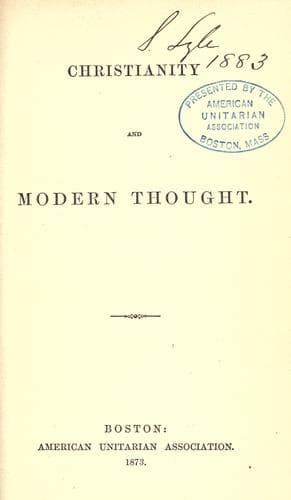
Christianity and Modern ThoughtPeabody, Andrew P. (Andrew Preston)
Religion
Christianity and Modern Thought
Peabody, Andrew P. (Andrew Preston)
Unitarianism
It is one of the miracles of the world--this life that is forever
losing, merging itself in a new life. We talk of martyrdoms; but there
are ten thousands of martyrdoms, of which the world never hears.
Beautiful it is to die for our country; beautiful it is to surrender
life for the cause of religious freedom; beautiful to _go forth_, to
bear help and healing to the sick, the wounded, the outcast and forlorn;
but there are those who _stay at home_, alone, unknown, uncelebrated, to
do and to bear more than is ever done, in one brief act of heroism or
hour of martyrdom. In ten thousand homes are those, whose life-long care
and anxiety wear and waste them to the grave. They count it no praise;
they consider it no sacrifice. I speak not, but for the simple truth, of
that which to me, is too holy for eulogy. But meet it is, that a
generation coming into life, which owes its training and culture and
preservation to a generation that is passing away, should be sensible of
this truth--of this solemn mystery of Providence--of this law of
sacrifice, of this outflow from self into domestic, into social life,
which lies at the very roots of the world.
There is one further application of the principle of disinterestedness,
which goes beyond classes and instances such as I have mentioned, and
embraces men simply as fellow-men. Much has been said among us of late
years, and none too much, of the dangers of an extreme individualism. We
began as a religious body, in a strong assertion of the rights of
individual opinion; and we went on in that spirit for a considerable
time; till it seemed, at length, as if we were liable to lose all
coherence and to fall to pieces in utter disintegration. But a few years
ago, moving in that zig-zag line which marks all human progress, we
awoke to the dangers of the situation; and happily found that if we
could not agree upon any technical definition of Christian faith, we
_could_ combine for Christian work. The National Conference was formed;
a new impulse was given; new funds were poured into our treasury; we are
circulating books and tracts more widely than we have ever done before;
we are helping feeble churches and founding new ones, besides doing
something for missions abroad: in short, we are trying to do the work
which, in common with other Christian communions, properly belongs to
us.
Public-domain text, read in full here on John Shaqi.
Reviews
Reviews
No reviews yet
Be the first to share your thoughts on this work.
Elsewhere in the archive
Join the Discussion
Join the discussion
Sign in to leave a comment or review.
Sign InorCreate an account