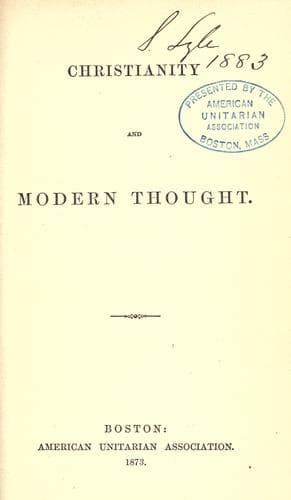
Christianity and Modern ThoughtPeabody, Andrew P. (Andrew Preston)
Religion
Christianity and Modern Thought
Peabody, Andrew P. (Andrew Preston)
Unitarianism
Men may win great admiration and great fame, but not great love; though
they gain, perhaps, as much as they give. Only by writing out of the
bosom of a great humanity _to_ the great humanity, can one fill the
measure of good art or good culture. Even Goethe, of whom Professor
Seeley says, that "he found every thing interesting except the fact that
Napoleon was trampling upon Germany"--a fatal exception: even Goethe,
with all his art, his marvellous versatility and fine accomplishment,
failed to reach the highest place, either in the best self-culture, or
in men's best love. _Savant_, poet, novelist, of high mark, as he was,
he has no such place as Newton, Wordsworth, and Walter Scott, in men's
love. Schiller and Richter, I believe, are more beloved in Germany, than
Goethe.
In mere art, in perfection of style, no writers have equalled Homer and
Shakspeare. But _they_ did not say, "Art for art's sake." They had no
thought but to communicate their thought. If singular felicities appear
in their style, little eddyings of exquisitely turned conceits, as
especially in Shakspeare, they made a part of, and swept on the strong
current of their ideas. They were not introduced for their own sake, or
merely to please the writer.
It has been said that great authors are born of great occasions. Some
remarkable era, some turn or tide in human thought, or in human affairs,
have borne them on to their supreme greatness. Will not the time come,
when men shall so look into the depths of the human heart, into the
tragic or blissful experiences of all human life, that no great era
shall be necessary to make great writers?
I believe it. I believe in a perpetual human progress--progress in every
kind, material, mental, moral, religious, divine; and I greatly desire
to say a few words in close, if you will indulge me upon this point. For
I found this faith in progress, on the two principles which I have been
considering in this lecture. Selfhood obliges a man to take care of
himself. To go out of himself is the only way, in which he can
take care of himself--can take care, that is to say, of his own
improvement and happiness. In selfhood, necessary as it is, there is
no virtue, and little joy. Outflow from it--love, generosity,
disinterestedness--embraces the whole sphere of our culture and welfare.
Can there be any doubt upon either of these points--either the culture
or welfare?
Public-domain text, read in full here on John Shaqi.
Reviews
Reviews
No reviews yet
Be the first to share your thoughts on this work.
Elsewhere in the archive
Join the Discussion
Join the discussion
Sign in to leave a comment or review.
Sign InorCreate an account