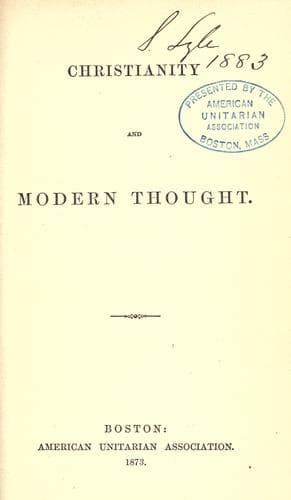
Christianity and Modern ThoughtPeabody, Andrew P. (Andrew Preston)
Religion
Christianity and Modern Thought
Peabody, Andrew P. (Andrew Preston)
Unitarianism
What a millennium would it begin, if, instead of this, every man should
be thinking, just so far as he can go beyond taking care of his own body
and soul, what he can do for others--not in any merely eleemosynary way;
not merely to instruct and improve men, with the pharisaic assumption of
being better or better off than they; but by acting a brotherly part
towards them, speaking neighborly words, doing neighborly deeds,
smoothing the path, softening the lot, seeing all erring and sorrow, and
joy and worth, as if they were their own; and wherever there is any
difficulty or trial or need, to "lend a hand." Whenever such a spirit
enters into and pervades society, it will make a world, compared with
which, _our_ time will sink back among the dark ages.
In short, when is it, that a man does and is, the highest that he is
capable of? The answer is, when forgetting himself, forgetting
advantage, gain, praise, fame, he pours himself out, in intellectual or
moral, and, any way, beneficent activity. When does culture or art in
him attain to the highest? It is when going beyond all thoughts of
culture and art, he flings himself, in perfect sympathy and free
communion, into the great mass of human interests. It is so that the
greatest things have been achieved in all the higher fields of human
effort--in writing, in eloquence, in painting and sculpture and music;
and it is so, especially, that the doers of great things, have become
the noblest men. "Art for art's sake," has been the motto for culture,
with some. And to a certain extent, that is true. It is fine to work for
the perfection of the work, and without any intrusion of self. But a man
may work so, upon a theme of little or no significance to the world's
improvement or welfare. He may work so, with small thoughts, small
ideals, for which nobody cares, or has any reason to care. But so can he
not work grandly, however finished be the result. Art is for the sake of
something beyond itself. Only when it goes out into great ideals that
mingle themselves with the widest culture and improvement of men, only
when it strikes for the right, for liberty, for country, for the common
weal, does it achieve its end.
We have had literature enough, and have it now, in which the writer
seems hardly to go beyond himself--writing out of himself and into
himself--occupied with making fine sentences, without any earnest
intent; and which readers, used to feed upon the honest bread of plain
English speech, hardly know what to make of. Very fine, these sparkling
sentences may be, very beautiful, very apt to strike with admiration;
but they divert attention with surprises, or cover up thought with
coruscations. They are like gems that lie scattered upon the table; they
are not wrought into any well-woven fabric; they do not move _on_ the
subject to any conclusion.
Public-domain text, read in full here on John Shaqi.
Reviews
Reviews
No reviews yet
Be the first to share your thoughts on this work.
Elsewhere in the archive
Join the Discussion
Join the discussion
Sign in to leave a comment or review.
Sign InorCreate an account